
The right container depends on more than capacity: product chemistry, closure design, filling temperature, headspace and transport classification all affect whether a pack performs safely. By the end, you will be able to prepare a supplier specification, identify when UN packaging approval is necessary, and compare tinplate options for paints, chemicals and lubricants stored or shipped from Bharuch.
Key takeaways
- Match capacity to sale unit, density, viscosity and dispensing method.
- Select closures for dispensing, leak prevention or dangerous-goods transport.
- Check tinplate and lacquer compatibility against the exact formulation.
- Specify headspace, filling limits, storage conditions and test documents.
How do you choose the right tin container size and shape?
Match the nominal capacity to the product’s sale unit, density, viscosity and dispensing method—not volume alone. Paint tins and greases often suit smaller pails or tins for controlled opening and application. Gear oil cans, hydraulic fluids and solvents may need larger capacities with closures designed for pouring.
| Shape | Main advantage | Limitation |
|---|---|---|
| Round | Easy pouring; less pressure concentration | Uses shelf and pallet space less efficiently |
| Rectangular | Fits shelves and pallets closely | Needs careful pouring and corner protection |
| Square or shaped | Improves grip and branding | Tighter limits on stacking and handling |
Compare the can with your actual pallet pattern before approving the design. Check the footprint, pallet count, handle clearance and pouring position; a visually compact can may block adjacent handles or reduce the number of packs per pallet.
Ask the supplier to confirm:
- Actual capacity and permitted fill level
- Length, width, height and empty weight
- Metal thickness and closure dimensions
- Suitable density and viscosity range
- Whether filling is ambient-temperature or hot
- Whether the design supports repeated dispensing or single-use opening
Do not assume a nominal 1-litre or 20-litre can accepts that exact quantity. Product density can make the sale-unit weight too heavy, while headspace and fill limits reduce usable volume. A viscous grease may require a wider opening than a low-viscosity solvent.
Approve samples after checking filling, lifting, pouring and stacking in the real operating position.
Which closure is suitable for storage, dispensing and dangerous-goods transport?
Choose the closure against the failure you need to prevent: repeated access, controlled pouring, vapour escape, ordinary spills or dangerous-goods leakage.
| Closure | Main advantage | Suitable use |
|---|---|---|
| Lever-lid cans | Fast repeated opening and closing | Paints, greases and workshop packs |
| Plug lid | Simple controlled pouring | Viscous oils, chemicals and lubricants |
| Screw cap | Repeatable opening with a defined seal | Liquid products requiring measured dispensing |
| Lined cap | Gasket or sealing layer improves liquid tightness when correctly torqued | Solvents and other leakage-sensitive liquids |
| Ring-open-end | Clean, tamper-evident full opening | Single-use packs, not repeated dispensing |
A friction-fit or lever-lid closure suits paint and grease opened repeatedly in retail or workshop use, but the lid compound and seam must match the formulation. A plug lid or screw cap gives better pouring control; confirm the torque specification rather than tightening by feel.
Volatile solvents need a compatible gasket and a verified torque or crimp specification that limits vapour and leakage during the intended handling and transport conditions. Do not confuse ordinary spill resistance with UN performance packaging.
UN approval under the UN Recommendations on the Transport of Dangerous Goods applies to a defined container design, closure, capacity, material and packaging group. Request:
- The complete UN mark
- The test certificate
- Closure and torque instructions
- Confirmation that the certificate covers your substance and packaging group
Drop, leakproofness, stacking and applicable hydraulic-pressure tests qualify transport performance. They do not prove that the internal lacquer suits your solvent blend or corrosive chemical.
How do you verify tinplate and lacquer compatibility with the formulation?
Compatibility depends on the complete chemical-contact system, not the word “tin.” Treat the tinplate steel, internal lacquer, weld or seam treatment, gasket and sealant as one system. Tin plating alone does not make a container suitable for paint resin, ketones, aromatic solvents, esters, acids, alkalis, amines, biocides or water-based additives.
1. Give the container supplier the complete formulation or a representative product sample. Ask whether the can uses an epoxy-phenolic coating, polyester lacquer or another solvent-resistant lacquer selected for those ingredients.
2. Require filled-pack testing at the intended storage temperature, followed by an elevated-temperature screen. Use the actual closure and fill level, not a blank metal coupon. Inspect the can for blistering, softening, delamination, rust, staining, swelling, seam or seal failure and leakage.
3. Test the product before and after storage. Record colour, odour, viscosity, skin formation and sediment, because a sound-looking can can still contaminate the formulation or change its performance.
4. Request the lacquer identification, coating coverage, seam treatment, gasket material and written results for the actual product family. “Chemical resistant” is a marketing description, not a compatibility rating.
5. Requalify the pack after changing the resin, solvent blend, additive, preservative or concentration. A formulation change can attack the lacquer, gasket or seam even when the container’s shape and tinplate steel specification remain unchanged.
What filling, headspace and storage limits must you confirm?
Get the operating limits in writing before production filling. A can that accepts the product chemically can still fail from overfilling, pressure or closure leakage.
1. Confirm the maximum fill quantity, required free headspace, product viscosity range and filling temperature. Record whether the container permits hot filling or only ambient filling; filling a cold-rated can with a hot product can distort the body, damage the lacquer or compromise the seam.
2. Check the headspace calculation at the highest storage temperature. Too little space can raise internal pressure as the product warms, while too much air can accelerate oxidation or skin formation in paints and lubricants. Volatile products need a closure and headspace arrangement that controls vapour pressure and leakage.
3. Ask how the pack protects light-sensitive pigments, additives and light-sensitive lubricants. Opaque tinplate blocks light, but the closure and seam still need protection from moisture and corrosion.
4. Confirm storage limits and inspection points. In Bharuch, keep cans under cover, off wet floors and away from standing water, condensation and chloride-contaminated air. Inspect cartons and pallets after monsoon exposure; reject packs showing rust, dampness or crushed protection.
For prepacked consumer products, confirm Indian Legal Metrology declarations, including net quantity and manufacturer or packer details. Classify an industrial transfer pack separately before finalising labels, artwork and nominal fill quantities, because its compliance route can differ.
What should you put in a Bharuch tin-container purchasing specification?
Write one chemical can specification for one product and one use case, not a generic request for industrial paint packaging. Identify the formulation and intended route before asking a Bharuch tin container supplier for prices.
- State the product name, full ingredient or solvent profile, target fill quantity, density, viscosity, filling temperature, storage temperature, expected shelf life, dispensing frequency and transport route.
- Specify the preferred shape, pallet footprint, handle requirement, closure type, gasket material, lacquer system, metal thickness, artwork and corrosion-protection requirements.
- Request a filled-pack compatibility report, closure instructions, sample cans and dimensional drawings. For dangerous-goods transport, request the UN packaging certificate, UN mark details and the certificate’s approved capacity, closure and packaging group.
- Classify the route before approving artwork: retail packs need the applicable Indian Legal Metrology declarations, while industrial transfer packs can follow a different marking position.
- Require monsoon-storage controls: covered pallets, separation from standing water, dry floors and protection from condensation and chloride-contaminated air.
Compare quotations against the evidence behind them, not unit price alone.
| Supplier check | Evidence to compare | Reject when |
|---|---|---|
| Compatibility | Filled-pack report at storage temperature plus elevated-temperature screening | Lacquer or gasket is described only as “chemical resistant” |
| Production | Tooling lead time, approved sample and batch consistency records | Capacity, dimensions or metal thickness is undefined |
| Distribution | Closure instructions, UN documentation and corrosion protection for Bharuch monsoon storage | Transport approval or closure performance is undefined |
Deccan Cans & Printers Pvt. Ltd. can be considered alongside other Bharuch-area suppliers only after confirming these details for your formulation; a catalogue category alone is not qualification.
Related product
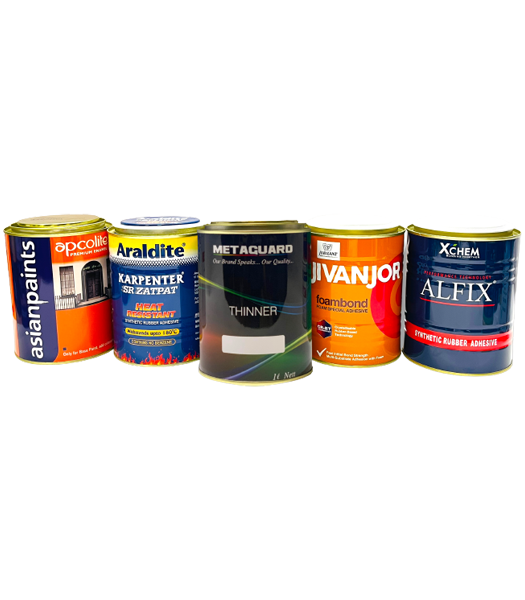 | Tin Containers Tin Containers Deccan Cans & Printers Pvt. Ltd. offers a robust range of Industrial Tin Containers, engineered to provide secure, durable, and... View product → |
Frequently asked questions
How do you choose the right tin container size and shape?
Match nominal capacity to the sale unit, product density, viscosity and dispensing method. Use smaller tins or pails for controlled paint and grease application, and larger cans with pouring closures for oils and solvents.
Which closure is suitable for storage, dispensing and dangerous-goods transport?
Choose a closure based on the use: controlled-opening lids for application, pour spouts or screw caps for dispensing, and tested, secure closures for dangerous-goods transport. Confirm the closure suits the product and transport requirement.
How do you verify tinplate and lacquer compatibility with the formulation?
Test the exact product against the specified tinplate and internal lacquer. Check for corrosion, swelling, softening, colour change, odour transfer, leakage and coating adhesion during the intended storage period.
What filling, headspace and storage limits must you confirm?
Confirm the net fill, container brimful capacity, required headspace, filling temperature, closure timing, stacking limits and storage temperature. Check extra space requirements when the product expands or releases vapour.
What should you put in a Bharuch tin-container purchasing specification?
State capacity, dimensions, body and lid style, tinplate gauge, internal lacquer, closure, gasket, decoration, net fill, compatibility test, leak-test requirement, dangerous-goods documentation and delivery conditions.