
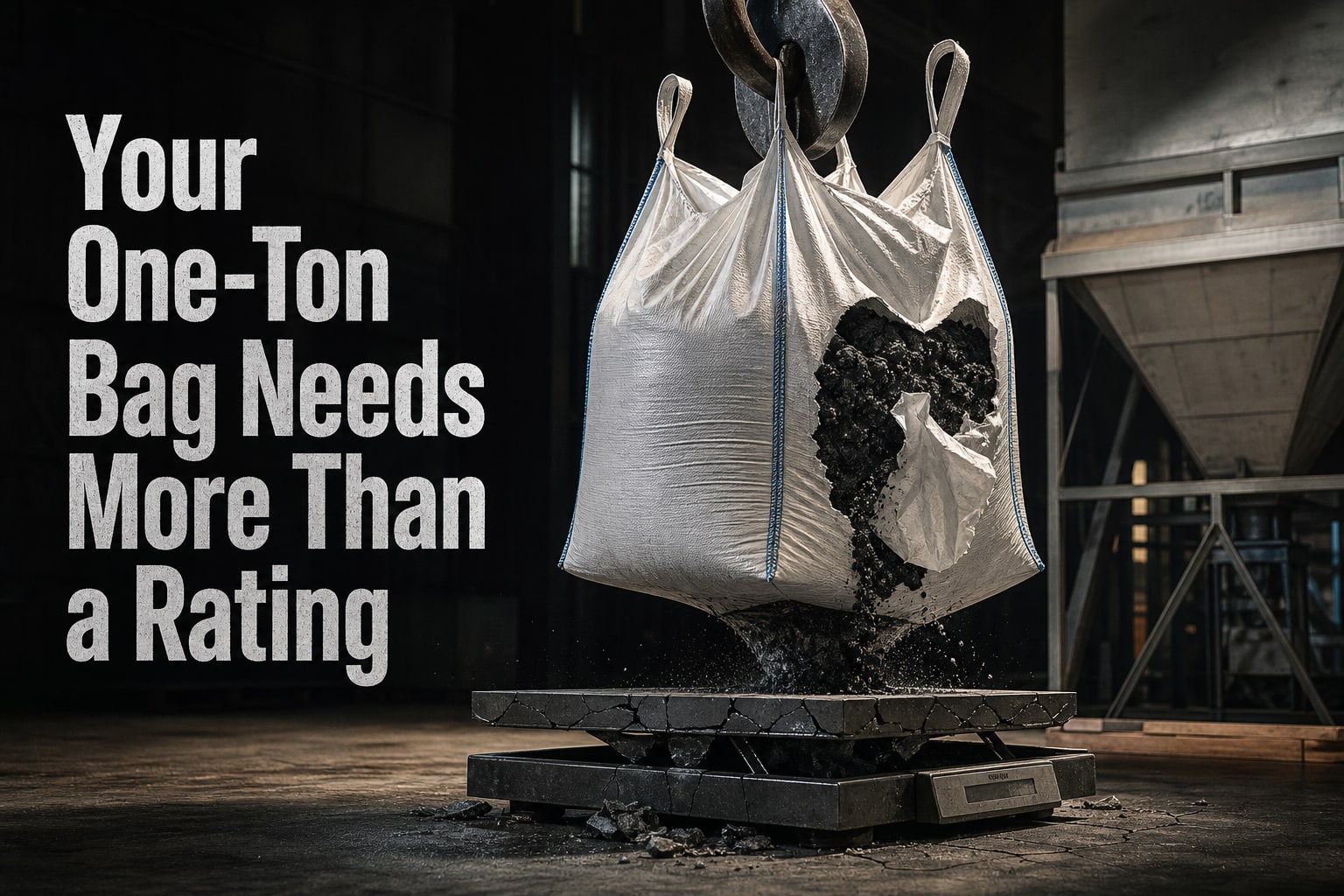
A “one ton bag” label does not prove that an FIBC can safely carry 1,000 kg in your process. You will be able to verify the true load rating, calculate the required volume, match the fabric and lifting design to your material, and request evidence that supports the purchase.
Key takeaways
- Confirm the bag’s SWL is at least 1,000 kg for your handling method.
- Calculate required volume from bulk density before ordering one-ton bags.
- Specify fabric, seams and liners against the material’s hazards.
- Check loops, closures, batch details and test documents before site use.
Verify the 1,000 kg Rating Before You Compare Prices
A 1,000 kg label does not prove that an FIBC can safely carry a one-ton load. “One ton bags” and “1000 kg bags” describe nominal payload, not the complete specification.
Before comparing prices, request:
- The stated safe working load (SWL), safety factor, bag drawing, test certificate, and production-lot identification.
- Written confirmation that the rating applies to your filling density, lifting arrangement, and service type.
- Evidence of construction and performance testing against ISO 21898, which covers FIBCs for non-dangerous goods.
A test certificate tied to the supplied production lot is stronger evidence than a catalogue photograph. “Heavy duty” alone proves nothing.
| Designation | Intended service | What it does not mean |
|---|---|---|
| 5:1 | Single-trip use | It is not automatically a 1,000 kg SWL |
| 6:1 | Controlled reuse | It does not permit unlimited reuse |
A 6:1 bag still requires inspection, suitable handling, cleaning controls, and the manufacturer’s written reuse conditions. Damage or a difficult lifting cycle can end its service immediately.
For dangerous goods, ISO 21898 evidence is not enough. Request the applicable UN packaging design-type approval and confirm that its marking matches the contents, packing group, liner, and closure. “Industrial bulk bags” and “jumbo bulk bags” are commercial terms, not separate technical classes; judge them by documented SWL and design details.
Calculate Bag Volume From Bulk Density, Not Payload Alone
Required volume in cubic metres equals mass in kilograms divided by bulk density in kilograms per cubic metre. A 1,000 kg load at 500 kg/m³ occupies about 2 m³; the same load at 1,000 kg/m³ occupies about 1 m³.
1. Establish the product’s actual bulk density before choosing dimensions. Free-flowing granules can settle during filling, while fluffy powders and aerated material occupy more space than their settled density suggests. Use the density range you will encounter, not a single laboratory figure.
2. Allow for headspace and filling behaviour. An undersized bag can become volumetrically full before it reaches its safe working load, preventing proper closure and creating pressure on seams or lifting loops. A catalogue volume that appears adequate on paper can fail once the material remains aerated or cannot settle evenly.
3. Confirm the specification with the supplier and your site team. Request filled length, width and height; usable volume; headspace; the tested density range; and compatibility with the filling machine, warehouse rack, truck body and discharge equipment.
One ton bags and 1000 kg bags describe nominal payload, not volume or complete performance. Industrial bulk bags and jumbo bulk bags are commercial terms, not separate technical classes. Compare the stated FIBC specification, dimensions and tested application rather than choosing by the label alone.
Match Fabric, Seams and Liners to the Material
Sharp or abrasive loads need strong fabric and protected seams; dusty, hygroscopic, or free-flowing products need control of leakage, moisture, and discharge.
| Material | Construction to compare | Main risk |
|---|---|---|
| Sharp or abrasive solids | Higher-denier polypropylene, wider tapes, tight weave, reinforced panels and tested seams | Punctures, scuffing, and seam failure |
| Fine or dusty powders | Tighter weave, coated fabric, or a fitted inner liner; fine stitching and sealed seams | Sifting through fabric and contamination |
| Hygroscopic products | Coated fabric plus a properly fitted liner and defined top and bottom closures | Moisture uptake; woven polypropylene alone is not a moisture barrier |
| Free-flowing granules | Uncoated or coated fabric matched to dust control, with a discharge spout and controlled closure | Sudden release or uncontrolled flow |
Ask for the polypropylene fabric denier, tape width, weave, coated or uncoated construction, seam type, reinforcement patches, and seam-strength test results. Do not accept “heavy duty” as a construction specification.
A liner improves contamination and moisture control, but it can restrict filling or discharge, complicate recycling, and create disposal work. Confirm its fit, attachment, material, and whether you must open or secure it separately at the outlet.
Select electrostatic protection from the product and handling environment, not payload size. Type C requires intact conductive elements and verified grounding during filling and discharge; a broken ground connection defeats the protection. Type D depends on its specified fabric system and contamination controls.
When comparing industrial bulk bags from heavy duty FIBC manufacturers in India, request these details in the drawing and test report.
Choose Lifting Loops and Closures for the Site Workflow
A rated loop that does not fit your forks can shift the load off-centre, tear fabric, and destabilise the bag. Put loop length, clear lifting height, loop strength, spacing, and forklift-tine compatibility on the drawing for every 1000 kg bag.
| Configuration | Handling fit | Main limitation |
|---|---|---|
| 1-loop | One compatible forklift hook or lifting point; simple crane handling | Poor balance if the load settles unevenly |
| 2-loop | Two hooks or a twin-fork arrangement; suits narrow access | Needs matched spacing and careful alignment |
| Four-loop | Four forklift tines or four crane hooks; best load balance | Needs greater rack clearance and correctly spaced equipment |
| Cross-corner-loop | Forklift tines or hooks engage loops across opposite corners | Incorrect engagement twists the bag |
| Sleeve | Forks enter fabric sleeves for stable lifting | Requires the specified tine width, length, and entry clearance |
| Tunnel | Forks pass through continuous tunnels; useful for repeated forklift handling | Blocked access or short tines can leave the bag unsupported |
| Single-point | One crane hook with a suitable lifting device | Not a substitute for forklift handling or uneven loads |
Never lift by the discharge spout, drag a filled bag, or let tines or hooks touch body fabric. Inspect for cuts, broken loops, open seams, and deformation before each lift.
Choose an open top or duffle top for direct filling, a filling spout for enclosed equipment, a plain bottom for manual emptying, and a discharge spout or self-closing outlet for controlled release. Specify spout diameter, length, tie or flap closure, separate liner access, and whether the receiver needs controlled flow or rapid full-bottom discharge.
A full-bottom outlet empties quickly but can release the entire load if opened incorrectly.
Build an Acceptance Checklist for the Supplier and the Site
Accept a shipment only when its documents and physical condition match the ordered specification. Request this acceptance package from the supplier:
- Final bag drawing showing dimensions, lifting configuration, spouts, closures, and liner fit
- Polypropylene fabric, denier, weave, coating, and tape specifications
- SWL, safety factor, and confirmation that the rating covers your filling density and service type
- ISO 21898 evidence where applicable, plus the relevant test report
- Production lot number linked to the supplied bags
- Lifting-loop details, closure details, liner specification, and written inspection criteria
Use this comparison at goods-in:
| Check | Acceptable evidence or condition | Reject or quarantine when |
|---|---|---|
| Lot identity | Bag marking matches the test report and delivery lot | Lot number is missing or cannot be traced |
| Construction | Loops, seams, panels, spouts, and closures match the drawing | Cuts, broken loops, open seams, distortion, or damaged spouts appear |
| Cleanliness | Interior and exterior are free from foreign material | Oil, moisture, residue, or other contamination is present |
| Handling readiness | No damage before the first lift or before reuse | Any defect could affect lifting or containment |
Inspect every bag before its first lift and before every reuse. Do not lift by the discharge spout, drag the bag, or expose its fabric to forks or sharp edges.
Store filled or empty bags covered, dry, and away from sharp edges. Record the supplier’s storage period and outdoor-exposure limit; UV stabilization does not allow indefinite outdoor storage. Compare heavy duty FIBC manufacturers in India on this evidence, not catalogue photographs. Deccan Cans & Printers Pvt.
Ltd. is worth comparing only when its supplied documentation matches your site criteria.
Related products
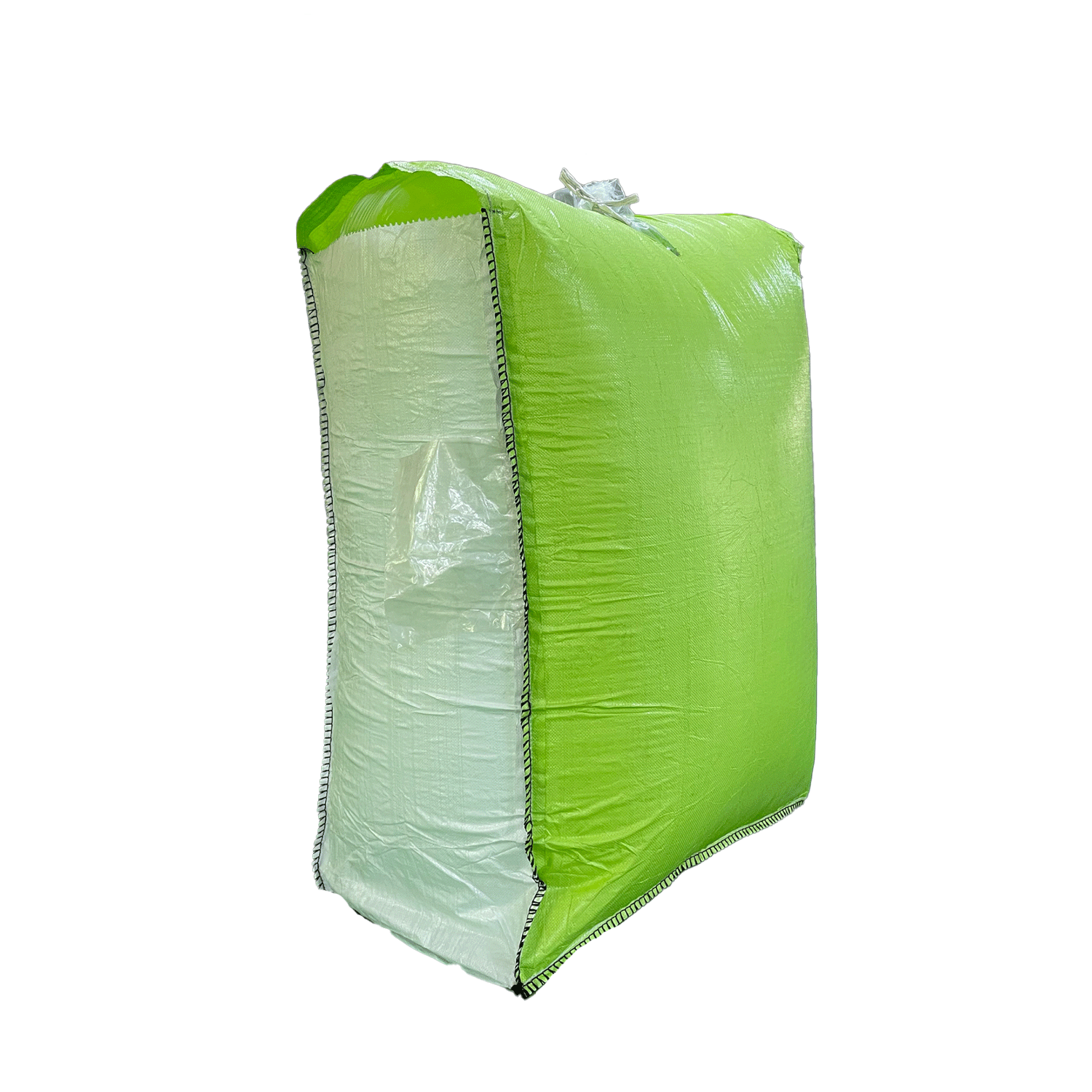 | FIBC Section Fertilizer Bag Range 1 & 2 Loop FIBC Bulk Bags Deccan Cans & Printers Pvt. Ltd. offers durable and cost-effective 1 & 2 Loop FIBC Bulk Bags, designed for the efficient... |
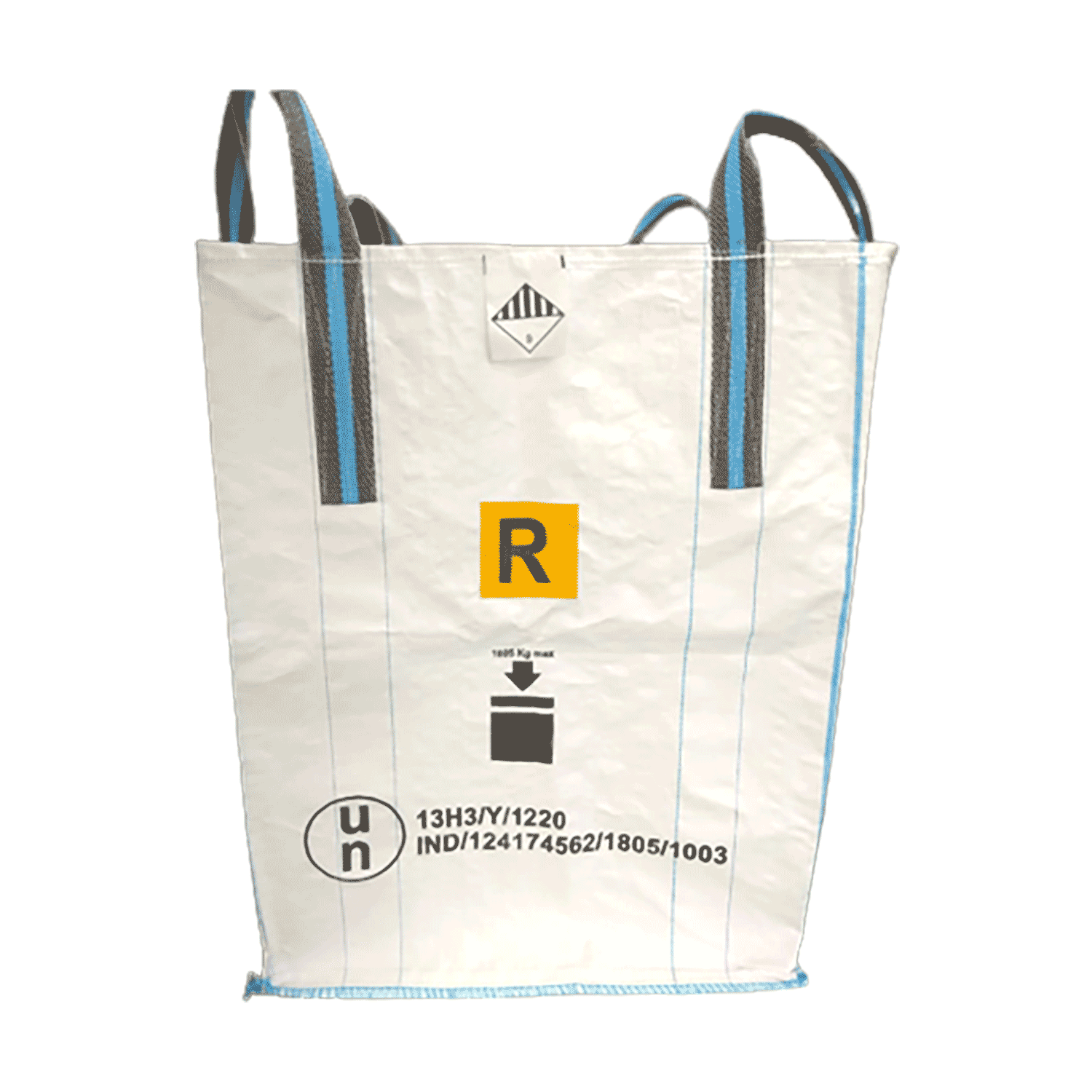 | FIBC Section Un Bags UN Certified Bulk Bags – Rigorous Performance Testing for Safety & Reliability Deccan UN Certified Bulk Bags are specially engineered for the safe... |
Frequently asked questions
Does a 1,000 kg label prove an FIBC is suitable for one ton?
No. Confirm the safe working load, safety factor, bag construction, lifting method and test documentation. A nominal 1,000 kg payload does not describe the complete specification.
How do you calculate FIBC volume for a 1,000 kg load?
Divide the load mass by the material’s bulk density. For example, a 1,000 kg load with a bulk density of 500 kg/m³ needs 2 m³ of internal volume, before allowing for filling and discharge requirements.
What should you specify for FIBC fabric, seams and liners?
Match fabric strength and coating to abrasion, moisture and static risks. Select seam construction and a liner that suit the material’s particle size, leakage risk, contamination controls and filling process.
Which lifting loops and closures suit industrial bulk bags?
Choose loop positions that match your forklift or lifting frame, then verify the equipment can engage all loops evenly. Match top inlets and bottom outlets to the filling, discharge and dust-control workflow.
What should you check before accepting one-ton bags from a supplier?
Check the printed SWL, bag dimensions, fabric and liner specification, seam condition, loop arrangement, closure type, batch identification and supporting test documents. Inspect bags again for damage before filling.
Related products
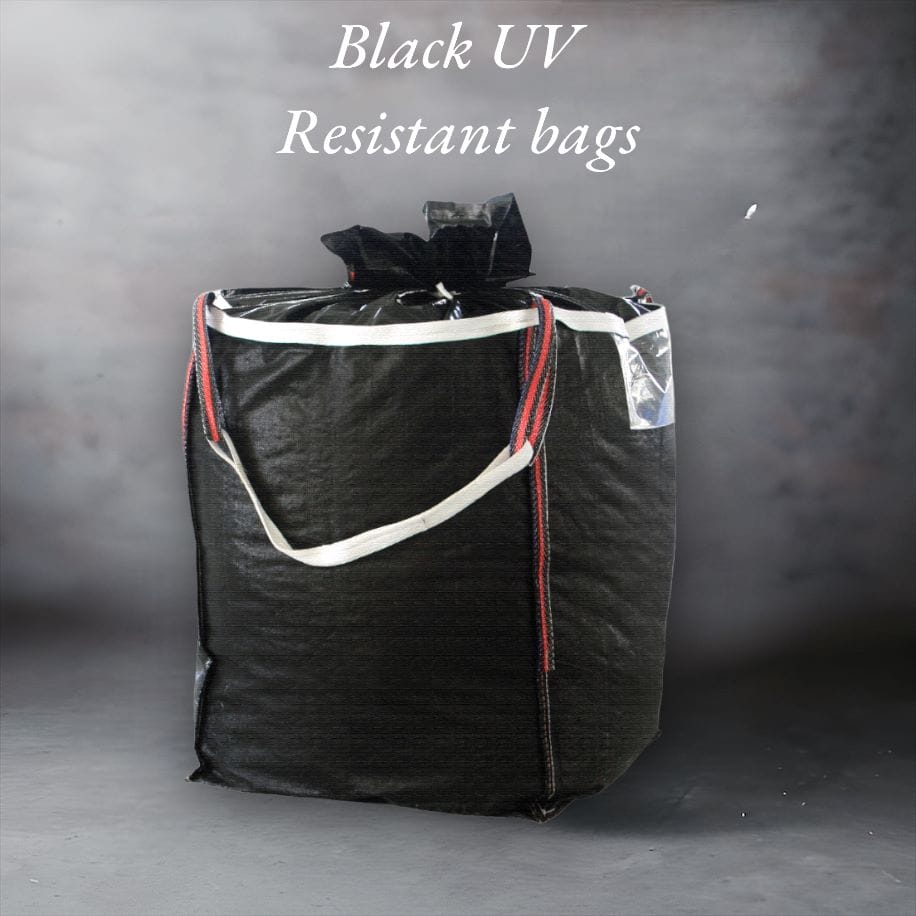 | FIBC Section Black Bags Black FIBC Bags – Enhanced UV Resistance & Extended Shelf Life UV exposure is one of the major challenges faced by the FIBC industry, as prolonged... |
 | FIBC Section Polyester Loop Bags/Multifilament Loops Polyester / Multifilament Loop FIBC Bags Deccan Cans & Printers Pvt. Ltd. |
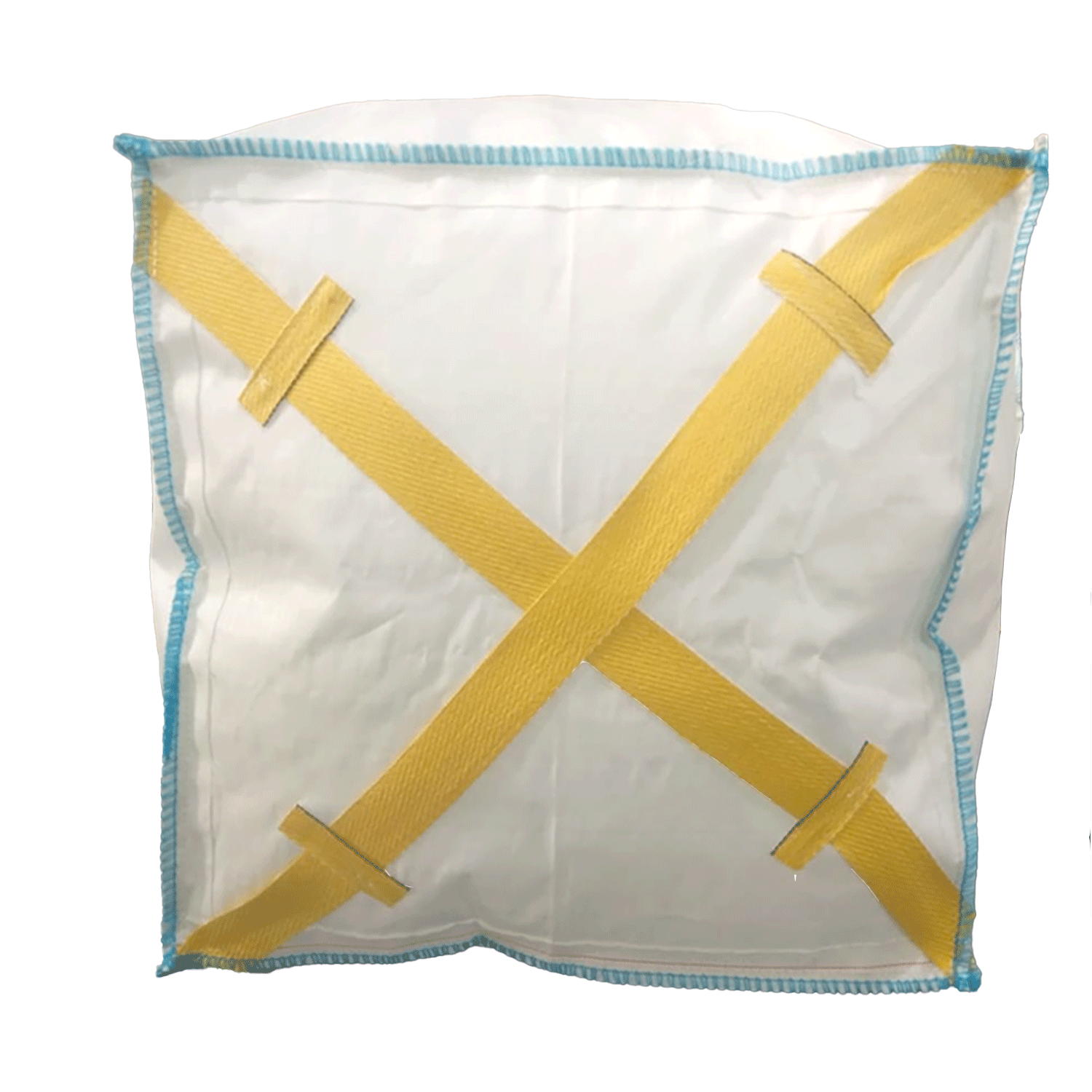 | FIBC Section Cross Bottom Sling Bags Cross Bottom Sling FIBCs – Bulk Bags Deccan Cans & Printers Pvt. Ltd. |
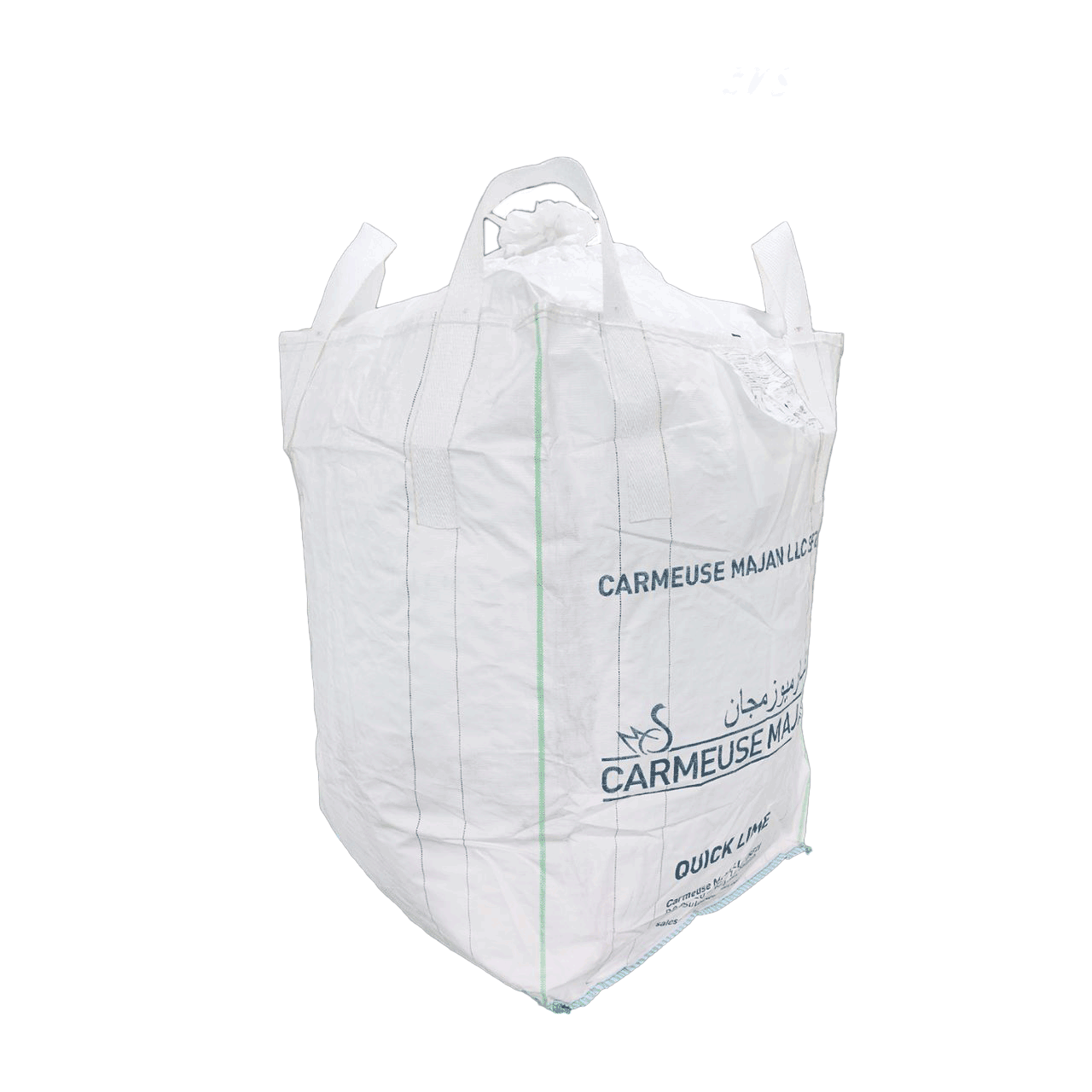 | FIBC Section Bags With Liners FIBC Liners – Bulk Bag Liners Deccan Cans & Printers Pvt. Ltd. |