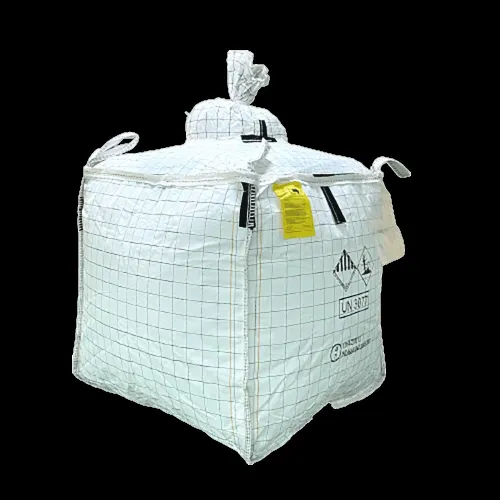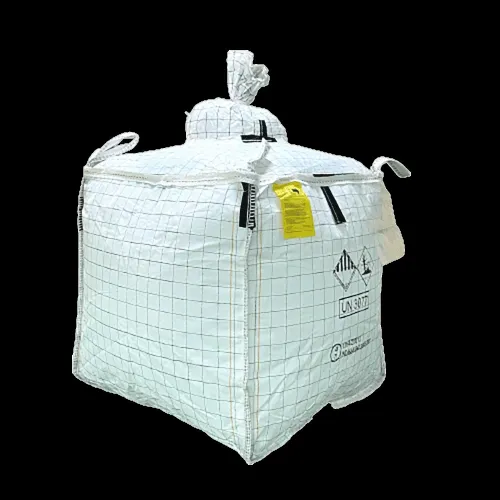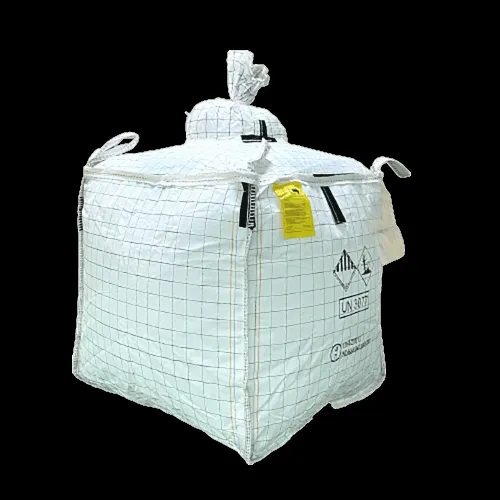

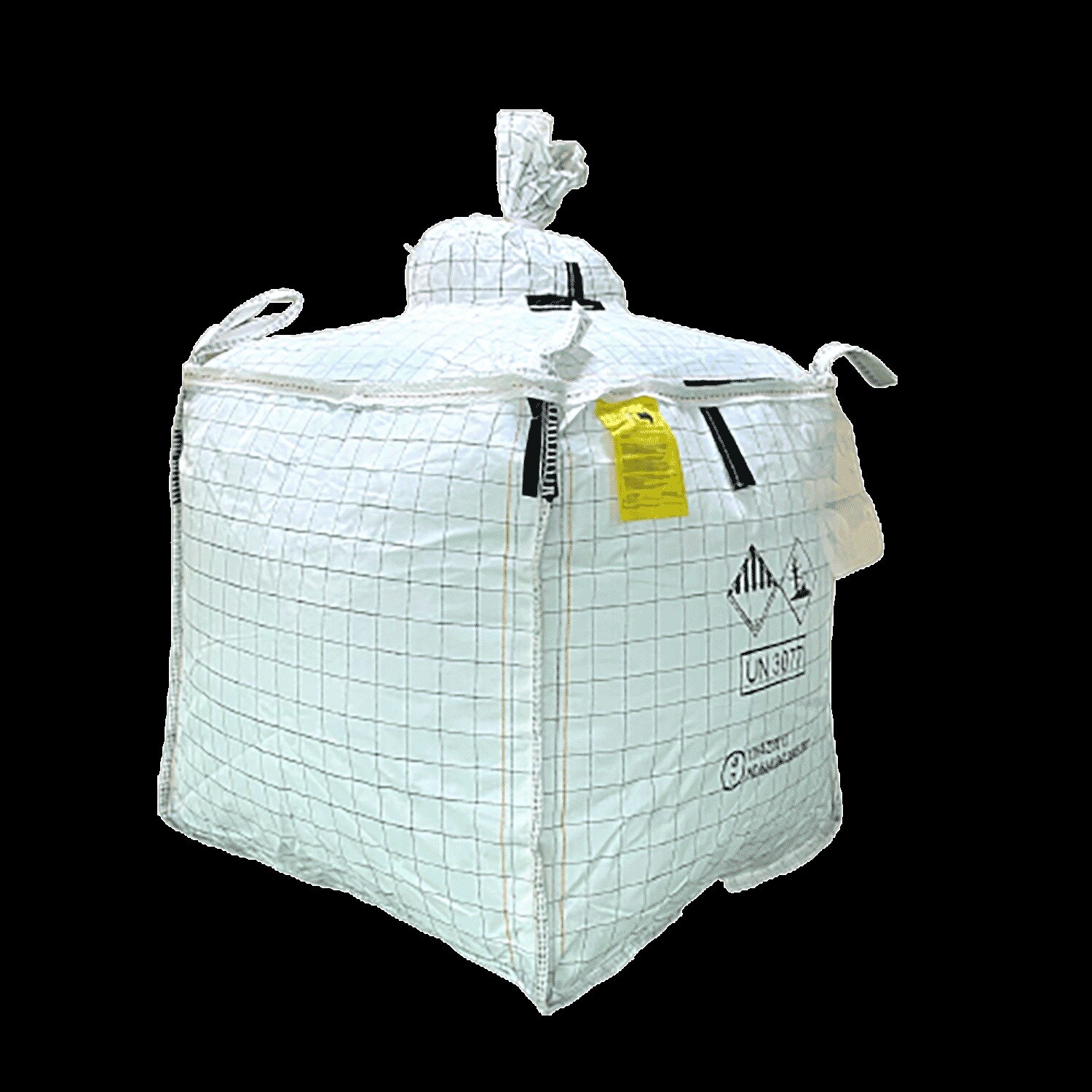
Safe FIBC selection starts with the material, hazard classification and handling system—not with a generic one-tonne rating. By the end, you will be able to specify the correct UN designation, electrostatic protection, lifting arrangement, moisture controls and transport documents for storage and shipments through Helsinki.
Key takeaways
- Match the bag’s SWL to its body, loops, seams, liner and lifting frame.
- Use a certified UN design when transporting dangerous goods.
- Ground conductive bags and control filling and discharge to reduce static risk.
- Specify moisture barriers, safe reuse limits and equipment-compatible spouts.
Start with the load, hazard and transport route
Define the load before you compare industrial FIBC bags. Record the product, bulk density, particle size, flowability, moisture sensitivity, temperature and required fill mass. Safe working load applies to the complete lifting system: body, loops, seams, liner, spouts and lifting frame must match the rated load and handling method.
Fewer lifting loops or abrasive forklift tines can invalidate the design load.
Before FIBC selection, document:
- Whether the material is dangerous goods, including its UN number and packing group.
- For combustible powder, minimum ignition energy, explosibility, charging behaviour, solvent vapour exposure and the plant’s ATEX hazardous-area assessment.
- Required moisture controls: liner, sift-proof seams, filling closure and discharge closure. Coating alone does not make fabric a moisture barrier; condensation and temperature changes affect bulk bags Helsinki storage.
- Whether the route uses road, sea or rail, and where loading, transfers and storage occur.
- Whether the bag is single-trip or reusable, including cleaning, inspection and recertification controls.
| Route | Governing requirement | What to define |
|---|---|---|
| Road from or through Helsinki | ADR | Classification, packaging, marking, labelling and transport documents |
| Sea leg | IMDG Code | Maritime dangerous-goods approval, packing, marking and documentation |
| Rail leg | RID | Rail classification, packaging, marking and documentation |
A UN-marked FIBC is not automatically suitable. Specify the tested design, such as 13H1, 13H2, 13H3 or 13H4, and match the completed bag’s fabric, seams, liner and closures to the substance; request the applicable drop-test level: 1.8 m for Packing Group I, 1.2 m for II or 0.8 m for III.
Choose the correct UN design for dangerous goods
A UN-certified FIBC is suitable only when its tested design matches the substance, packing group and transport route. Check the completed bag’s UN specification marking, certificate or test report; approval applies to the fabric, seams, liner and closures, not merely to polypropylene or the manufacturer.
UN packaging codes identify the bag construction:
| Code | Construction | What to verify |
|---|---|---|
| 13H1 | Woven plastic without liner or coating | Suitable only when the product and sift control permit this construction |
| 13H2 | Woven plastic with an inner liner | Confirm liner material, fit and closure |
| 13H3 | Woven plastic with an outer coating | Confirm the coating is part of the tested design |
| 13H4 | Woven plastic with an inner liner and outer coating | Confirm both features match the approved design |
The bag must have passed the applicable UN performance tests: drop, top-lift, stacking, tear and topple. The drop-test height is 1.8 m for Packing Group I, 1.2 m for Packing Group II and 0.8 m for Packing Group III. Do not accept a generic “UN FIBC” claim without the designation and test evidence.
Check electrostatic compatibility separately. Type C requires grounding during filling and emptying; its resistance from the groundable point must not exceed 1.0 × 10^7 ohms under IEC 61340-4-4. A UN mark does not replace ADR compliance for road transport from Helsinki, or IMDG and RID checks for sea and rail legs.
Control static electricity during filling and discharge
Select the electrostatic type from the powder’s minimum ignition energy, explosibility, charging behaviour, solvent vapour exposure and hazardous-area assessment. “Anti-static” alone is not a safe specification; under ATEX workplace rules, you must assess the complete bag-and-process combination.
| Type | Electrostatic behaviour | Grounding and use |
|---|---|---|
| Type A FIBC | Provides no electrostatic control | Do not use for combustible powders or where an ignitable atmosphere can form |
| Type B FIBC | Limits the energy of propagating brush discharges | Use only where no flammable atmosphere is present; it is not a substitute for grounding |
| Type C FIBC | Conductive components discharge charge through an earth connection | Ground before filling and emptying; IEC 61340-4-4 sets a maximum resistance to the groundable point of 1.0 × 10^7 ohms |
| Type D FIBC | Dissipates charge without a separate earth connection under specified conditions | Use only within the design and certification limits, including the stated powder, equipment and atmosphere conditions |
For Type C FIBC, bond the designated grounding point to a verified plant earth before opening the filling valve. Check the connection, continuity and resistance before every operation; an operator touching the bag is not an adequate earth path. Stop if the grounding clamp, cable or conductive threads are damaged.
Type D FIBC can simplify handling, but certification does not approve every process. Confirm the selection against the filling and discharge equipment, dust-control measures and hazardous-area assessment, then document the operating limits for Helsinki’s indoor and outdoor handling conditions.
Check load capacity, moisture protection and reuse
Treat the rated FIBC safe working load as a rating for the complete lifting system, not just the woven body. Confirm that the loops, corner seams, lifting sleeves, discharge spout, liner and lifting frame match the load and lifting method; fewer loops or forklift tine abrasion can invalidate the design assumption.
ISO 21898 distinguishes single-trip and reusable construction through design safety factors. Common specified ratios are 5:1 for single-trip bags and 6:1 for reusable bags, but a bag that passed one lifting test is not automatically suitable for repeated use.
- Check the bag marking for its safe working load, lifting configuration and intended number of trips.
- Reject a coated-fabric bag as a moisture barrier; specify a suitable liner, sift-proof seams and defined filling and emptying closures.
- Account for condensation, wet loading bays and winter-to-warm-warehouse temperature changes around Helsinki. Specify a FIBC liner Helsinki operations can inspect and replace.
- Before each reuse, inspect fabric, loops, seams, closures and discharge spout for abrasion, cuts, distortion or residue.
- Document cleaning and validate it where product contamination matters. Washing can change electrostatic behaviour and leave moisture inside seams.
- Keep traceability for each reusable FIBC and define a rejection rule before damage occurs.
Use a reusable FIBC only when it is designed, marked, inspected and cleaned under that programme. Residue from the previous load can contaminate the next one, while weakened loops can fail during lifting even when the body looks sound.
Specify the bag around Helsinki’s equipment and compliance needs
Set the specification from the interfaces outward: measure the filling machine, discharge point, pallet, rack, forklift and vehicle before choosing FIBC dimensions. A nominal one-tonne capacity is irrelevant if the filled bag blocks a forklift mast, the outlet cannot reach the hopper, or the base is unsupported in storage.
Put these fields on the purchase specification:
- Filled length, width and height, with maximum height under rack and vehicle clearances
- Safe working load, safety factor and stacking arrangement for the actual storage period
- Top inlet, bottom outlet, liner, sift-proof seams and closure dimensions
- Loop configuration, lifting method, pallet footprint and required handling equipment
- Fabric, coating, UV exposure limit and electrostatic type matched to the hazardous-area assessment
Specify moisture control as a complete system, not merely “coated fabric.” For hygroscopic powder, name the liner material, seam construction and filling and emptying closures; condensation during winter-to-warm warehouse transfers can still damage an exposed product.
Write the transport route beside the bag design. ADR FIBC transport applies to road legs from Helsinki, RID to rail legs, and IMDG Code FIBC requirements to sea legs.
State the substance, UN number, packing group, UN code such as 13H1 or 13H4, and required marking; a UN mark alone does not prove correct classification, labelling or documentation.
The business is an FIBC supplier Helsinki buyers can ask for a written build sheet that ties liner, closures, dimensions and lifting loops to their equipment rather than accepting “anti-static” as a complete specification.
Frequently asked questions
What information should you record before choosing an industrial FIBC bag?
Record the product, bulk density, particle size, flowability, moisture sensitivity, temperature and required fill mass, then match the complete lifting system to the safe working load.
When do you need a UN design for an FIBC bag?
Choose a UN-certified FIBC when the contents are classified as dangerous goods and the applicable transport rules require approved packaging for that substance and route.
How do you control static electricity when filling or discharging an FIBC?
Identify the bag type, bond and ground conductive components, use compatible equipment, and control the filling and discharge rate before handling combustible powders or flammable vapours.
How do you compare FIBC bags for moisture protection and reuse?
Check the liner and fabric construction against the product’s moisture sensitivity, inspect the bag’s lifting components after each use, and reuse it only when its design and inspection procedure permit reuse.