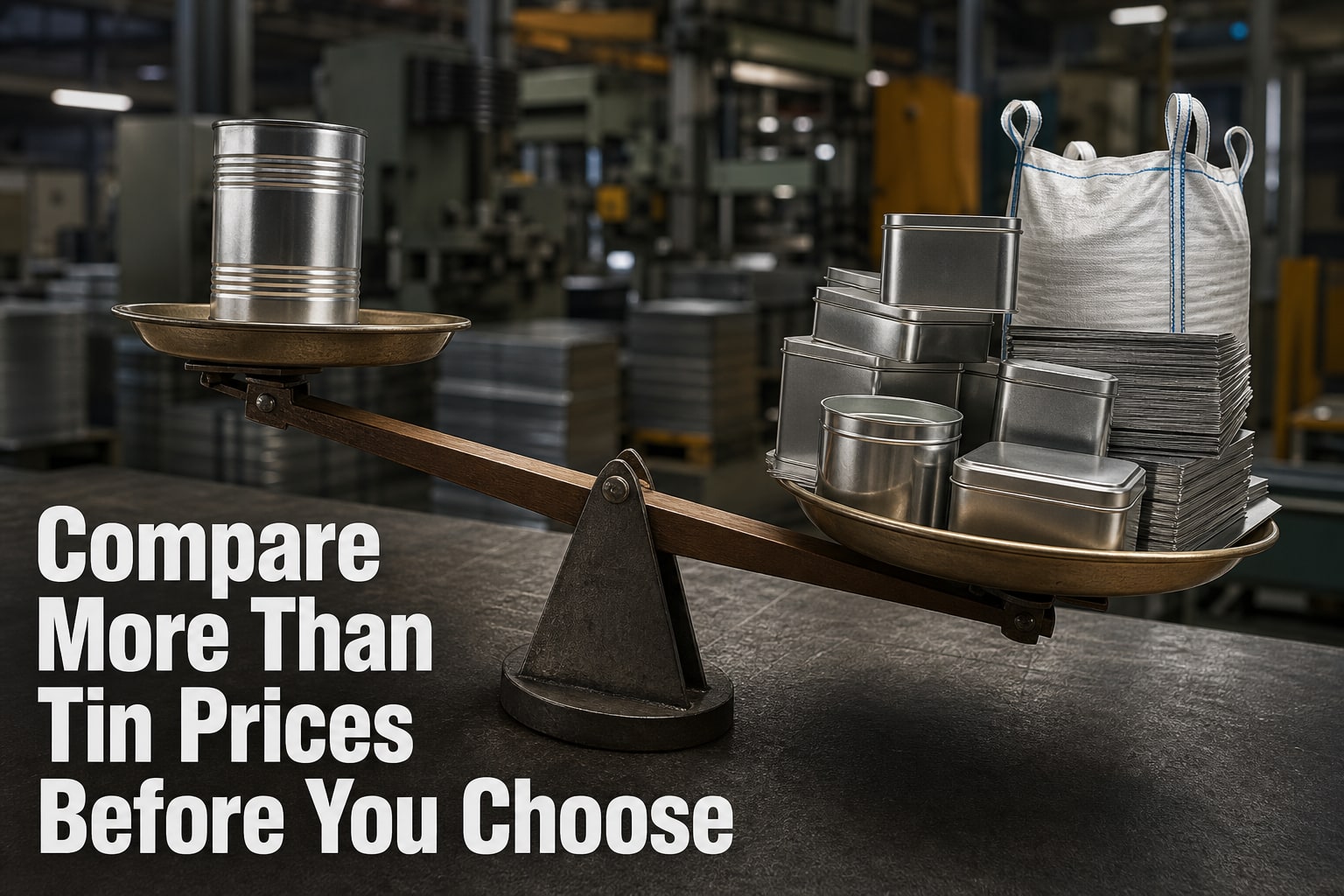
A low ex-factory quote does not tell you whether a supplier makes tins, outsources production, or can deliver a compatible container on schedule. By comparing manufacturing capability, logistics, specifications, compliance evidence, quality controls and commercial terms, you can choose between Mumbai and Daman on delivered performance rather than location alone.
Key takeaways
- Verify the registered factory address and inspect slitting, printing, forming and testing equipment.
- Compare freight, labour, infrastructure and delivered costs—not factory location alone.
- Request material grades, dimensions, coatings, test reports and food-contact compliance documents.
- Negotiate MOQ, tooling ownership, lead time and delivery terms before approving samples.
Which companies actually manufacture tins in Mumbai and Daman?
A genuine tin can manufacturer in Mumbai or tin container manufacturer in Mumbai can show a registered factory address, production records and the machinery that matches your specification. A supplier using a third-party plant may issue the invoice but cannot explain where slitting, printing, coating, body forming, welding, seam assembly and testing occur.
| Supplier type | Evidence to request | Warning sign |
|---|---|---|
| Mumbai manufacturer | Factory visit, machine list, batch records and samples made on the stated line | Only a sales office or warehouse |
| Daman manufacturer | Factory address, utility-backed production area, in-house process records and traceable dispatch lots | “Daman supply” with no manufacturing location |
| Trader or outsourced supplier | Written disclosure of subcontractors and records linking each operation to your lot | Refusal to identify the actual plant |
Ask whether the line makes welded three-piece cans, drawn-and-ironed two-piece cans or fabricated containers. Tooling, shapes, seams, production speed and economical batch size differ, so a quote is not comparable until the process is named.
- Verify the plant’s legal address, ownership or lease, machinery photographs, recent production logs and retained samples.
- Ask which operations are subcontracted, how materials move between sites and who controls nonconforming stock.
- Put sampling level, AQL or zero-defect characteristics, test frequency, lot traceability, retained samples and change notification in the purchase order.
- Define the response to leakage, dimensional failure or bag-test failure before production begins.
The phrase tin container manufacturer daman proves nothing by itself; documented process control does.
How do Mumbai and Daman compare on freight, labour and infrastructure?
A lower ex-factory quote does not guarantee a lower delivered cost: empty tins move substantial air and steel, so route length, truck availability, damage and unloading time matter.
Mumbai usually suits customers across the Mumbai Metropolitan Region or shipments through Jawaharlal Nehru Port (Nhava Sheva); Daman can serve the Vapi–Daman industrial belt with shorter road legs.
| Location | Freight and access | Labour and utilities | Supply implication |
|---|---|---|---|
| Mumbai | Close to metropolitan customers, major warehouses and Nhava Sheva, but city congestion can disrupt collection and delivery slots. | Larger manufacturing labour pool; verify the factory’s sanctioned electrical load, backup power, water and maintenance response. | Stronger for frequent local deliveries and port-linked export cargo. |
| Daman | Direct road access to Vapi and nearby Gujarat industrial customers; longer Mumbai deliveries add freight and transit exposure. | Industrial-estate infrastructure can be suitable, but confirm skilled operators, backup power and service support before committing. | Stronger when your customers and raw-material routes are concentrated north of Mumbai. |
| Either location | GST location alone creates no automatic saving. Compare freight basis, loading charges, e-way-bill responsibility and packaging tax treatment. | Outsourced slitting, printing, coating or testing adds queues and traceability risk. | Select the supplier with proven in-house stages and a lower delivered damage rate. |
For a “metal container factory daman” or “tin container manufacturer daman”, request route-wise transit records, rejected-load data and backup arrangements. Apply the same test to a “tin container manufacturer in mumbai”; a nearer factory is not more reliable if it depends on subcontractors.
- Compare three delivered quotations using the same delivery address, lot size, unloading terms and acceptance procedure.
- Confirm alternate transport routes, dispatch cut-off times and escalation contacts before placing the order.
What container specifications and compliance documents should you compare?
Two tins are not equivalent because their dimensions match. Compare the steel grade, tin-coating designation, temper, thickness, internal lacquer, external varnish, ink system, closure and manufacturing process.
| Specification | What to compare | Why it matters |
|---|---|---|
| Construction | Welded three-piece or drawn-and-ironed two-piece; seam, neck, lid and tooling | These processes impose different shapes, strengths, speeds and economical batch sizes |
| Material | Tinplate or tin-free steel, grade, temper, thickness and coating mass | A thinner or harder substrate can change dent resistance, forming and corrosion performance |
| Finish | Lacquer chemistry and coat weight, varnish, inks, gasket, solder or weld areas | The complete contact system controls migration, odour, corrosion and product compatibility |
| Performance | Dimensions, fill volume, headspace, leak test, seam inspection, stacking load and retort or sterilisation conditions | A closure or seam that suits dry goods can fail with hot, pressurised or liquid contents |
Give the supplier the formulation, pH, salt or sulfur content, solvent exposure, fill temperature, shelf-life target and sterilisation cycle before selecting the coating. A metal packaging manufacturer in Mumbai should quote a finished-pack test basis, not only a steel-sheet specification.
Request the steel certificate, coating and food-contact declarations, migration and compatibility reports, batch traceability, retained-sample policy and change-control procedure. A tin container manufacturer in Mumbai should also state the inspection level, AQL or zero-defect criteria, test frequency and leakage rejection process.
For chemicals, confirm resistance against the actual formulation and obtain the safety data sheet review.
How do you verify machinery, testing and production capacity?
A factory tour should prove that the quoted process happens on site, not merely that finished tins are stored there. Ask to see the steel coil or sheets entering the line, machine nameplates, current job cards and the route from slitting through printing, coating, stamping, body forming, seam or lid assembly and packing.
- Match each operation to visible equipment: slitter, printer, coating or curing oven, press, welder or soldering station, curl-and-bead machine, and closure assembly tools. A metal packaging manufacturer in Mumbai that outsources one stage should identify the subcontractor, transport record and inspection hand-off.
- Confirm whether the line makes welded three-piece cans, drawn-and-ironed two-piece cans or fabricated containers; tooling, seam construction, shapes and economical batch sizes differ.
- Inspect a test area containing calibrated instruments for dimensions, flange and curl, coating adhesion, leak or vacuum performance, seam integrity and stacking strength. Request recent reports for the finished container, including lacquer, varnish, ink, gasket and closure compatibility.
- Trace one packed lot backward using its batch number, steel specification, coating batch, machine, operator, inspection results and retained sample. Missing links expose weak recall control.
- Test usable capacity, not brochure capacity: compare the rated output with recent production logs, changeover time, rejected units, shifts, maintenance downtime and confirmed orders. Ask for spare capacity on your exact size and decoration.
A metal container factory in Daman can pass these checks too; location alone proves no integration. Apply the same evidence request to Deccan Cans and Printers Pvt. Ltd. before comparing its quoted lead time with a Mumbai or Daman rival.
How should you compare MOQ, tooling, lead time and delivered purchase terms?
Compare total delivered cost per accepted unit, not the quoted price of an empty tin. A tin can manufacturer in Mumbai may suit nearby customers, while a tin container manufacturer Daman may reduce freight into the Vapi–Daman belt; neither advantage matters if rejects, damage or slow reorders consume the saving.
| Quote item | Make suppliers state | Commercial risk to price |
|---|---|---|
| MOQ and process | Quantity by size, gauge and decoration; welded three-piece, drawn two-piece or fabricated construction | Tooling and economical batch sizes differ; an apparently cheaper can may require a larger stock commitment |
| Tooling and artwork | Moulds, dies, cylinders, plates, prototypes and approval rounds; ownership and reuse rights | One-time charges can make the first order expensive and complicate supplier changes |
| Delivery basis | Ex-works or delivered, freight, loading, insurance, GST, e-way-bill responsibility and packaging charges | Empty cans carry air and steel; compare landed cost, transit days and damage allowance |
| Payment and replenishment | Advance, credit period, production lead time after approval, reorder lead time and reserved capacity | A low price tied to full advance payment or a long reorder queue increases working-capital and stockout risk |
| Acceptance | Sampling plan, AQL or zero-defect characteristics, dimensions, leakage tests, retained samples, lot traceability and complaint resolution | Define rejection, replacement and freight responsibility before production |
Ask a metal packaging manufacturer in Mumbai for the same finished-pack compliance documents, including lacquer, ink, gasket and closure compatibility. Approvals must cover the complete container, not just the steel sheet.
Frequently asked questions
Which companies actually manufacture tins in Mumbai and Daman?
A genuine manufacturer can show a registered factory address, production records and machinery for slitting, printing, coating, forming, welding, seam assembly and testing. Ask where each process occurs and whether subcontractors are used.
How do Mumbai and Daman compare for tin container manufacturing costs?
Compare the complete delivered cost, including freight, labour, utilities, loading, transit time and infrastructure reliability. A lower factory price in one location can disappear after transport and handling costs.
What specifications and compliance documents should you compare?
Compare steel or tinplate grade, thickness, dimensions, tolerances, coating, closure, seam design, printing requirements and testing. Request material certificates, coating or ink declarations, test reports and food-contact documents when the application requires them.
How can you verify a tin manufacturer's machinery and production capacity?
Inspect the factory or request dated video evidence showing the machines named in your quotation. Match machine widths, forming methods, welding or seaming equipment, inspection tools and production records to your order volume.
How should you compare MOQ, tooling, lead time and delivered purchase terms?
Obtain written terms covering minimum order quantity, tooling cost and ownership, sample approval, production lead time, payment, packaging, freight, insurance, delivery location and responsibility for rejected goods.