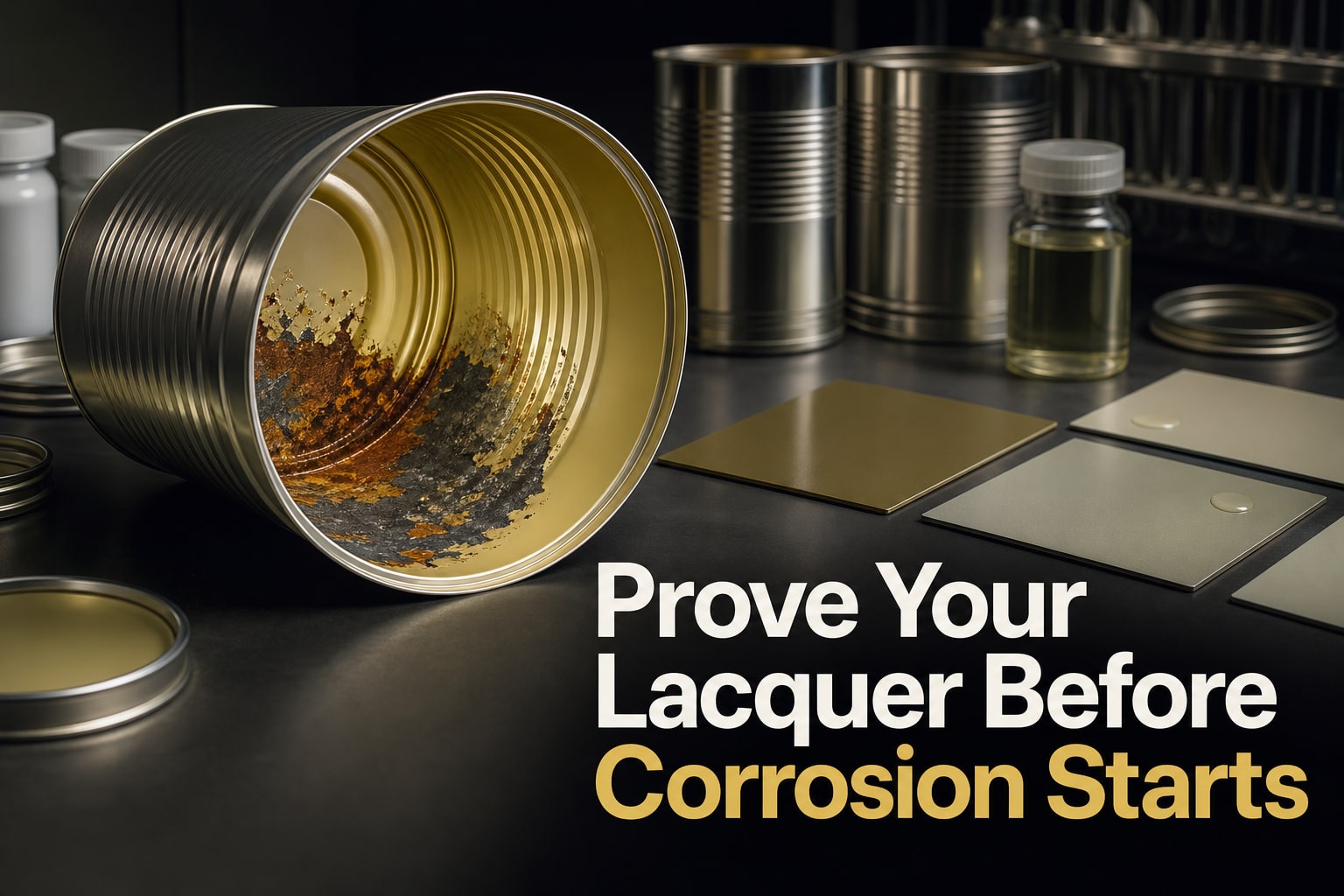
Corrosion inside a can usually points to a failed barrier, an incompatible formulation, or damage introduced during forming and seaming—not simply a lack of tinplate thickness. By the end, you will be able to identify the failure mode, match a lacquer to the actual product chemistry, and define tests that separate coating problems from seam and manufacturing defects.
Key takeaways
- Inspect exposed steel at seams, scratches, and end coatings first.
- Compare product pH, solvents, salts, acids, and storage temperature with lacquer resistance data.
- Run filled-can compatibility tests before approving a production batch.
- Specify lacquer type, coverage, seam protection, test method, and acceptance limits.
What internal lacquer changes inside a tin can
Internal lacquer sits on the product-contact surfaces of the can body, ends, and any coated seam areas. Its continuous film separates the contents from the tinplate substrate, so continuity matters: a small exposed point can become the start of corrosion beneath an otherwise intact coating.
Tinplate alone is not enough. Tin is normally cathodic to exposed iron, so a scratch, pore, cut edge, or damaged seam can make the exposed steel a localized anodic corrosion site. Internal product-side corrosion differs from external corrosion on the outside of the can.
- Pitting: small, deep metal attacks that can perforate the wall.
- Pinholing: tiny coating or metal-through defects that admit product to the substrate.
- Blistering: raised areas caused by gas, moisture, or corrosion beneath the film.
- Delamination: loss of adhesion that lifts coating from the metal.
- Seam corrosion: attack at a side seam, flange, or double seam where coating or sealing is incomplete.
Internally lacquered tin cans work as a barrier system, not as a cure for poor forming or seaming. Performance depends on dry-film thickness, cure, adhesion, forming resistance, and defect control; excessive thickness can crack during bending, while under-cure can weaken chemical resistance.
A holiday or pinhole test finds electrically conductive discontinuities, but it does not prove long-term resistance to chemical attack, underfilm corrosion, or retort exposure. Seam integrity requires separate verification.
Which product chemistries attack the coating or metal
A lacquer protects the tinplate only while its film remains chemically stable and adhered.
Acidic and saline contents can drive pitting through defects; alkaline contents can undermine adhesion; oxidising products can attack the film or exposed steel; sulfur compounds can create black or brown sulfide staining; and alcohols or solvents can soften, swell, or extract coating components.
“chemical resistant tin cans” is not a complete specification, and product pH alone cannot select a lacquer.
Record the exposure before choosing the system:
- pH, titratable acidity, chloride and other salt levels, sulfur compounds, dissolved oxygen, and water activity.
- Alcohol or solvent content, surfactants, preservatives, free fatty acids, active pesticide ingredients, and concentration.
- Fill condition, headspace, contact time, storage temperature, shelf life, and any retort or pasteurization cycle.
| Lacquer family | Relevant strengths | Main compatibility questions |
|---|---|---|
| Epoxy-phenolic | Strong adhesion, solvent resistance, retort performance, and sulfur-stain resistance | Are extractables and formulation restrictions acceptable? |
| Organosol | Flexible, thick film with good forming resistance | Will plasticizer migration, solvents, or heat affect the film? |
| Polyester | Good flexibility and chemical resistance with low extractables | Does the grade retain adhesion through retort? |
| Acrylic | Clear film and useful chemical or weathering resistance | Does it withstand the product, heat, and forming strain? |
| Oleoresinous | Flexible, economical barrier for selected products | Will oils, solvents, sulfur, or long storage soften it? |
BPA-NI describes a formulation characteristic, not automatic corrosion protection, food-contact compliance, retort resistance, or chemical compatibility. Compare named chemicals at their actual concentrations, temperatures, contact times, and processing conditions; a room-temperature pass does not predict hot-water or steam performance.
How to diagnose whether corrosion began in the product or the can
A metallic taste or odour, discoloration, rust particles, black or brown sulfide staining, sediment, pressure loss, or leakage points to a product-side failure, but not necessarily a lacquer failure. Open retained cans and record whether the product changed before inspecting the package.
- Compare unused, filled, stored, and thermally processed samples. A defect appearing only after filling indicates product compatibility or processing stress; one present in unused cans indicates manufacture or coating damage.
- Photograph the inside at the lid, side seam, flange, score, bead, and double-seam region. Blistering suggests trapped moisture or poor adhesion; whitening or softening suggests chemical attack; adhesion loss or delamination suggests poor cure, incompatible lacquer, or forming damage.
- Check for pitting and pinholing. Relate them to an exposed cut edge, coating damage from drawing or necking, microcracks or crazing, incomplete repair lacquer, or lacquer breakdown after storage above the validated temperature.
- Check seam integrity separately. Seam leakage can result from an incorrectly formed seam, unsuitable closure compound, excessive seam squeeze, incomplete repair coating, or an unsealed side-seam area; internal lacquer cannot correct these defects.
External rust belongs to a different pathway: inspect the outside for wet storage, damaged tinplate, and rust tracking from a seam. Internal attack that follows a scratch, flange, or pore is localized product-side corrosion. Confirm the distinction by examining metal containers and tinplate containers before and after filling, processing, and storage.
How to prove lacquer compatibility before releasing a fill
Do not release a fill from a new internally lacquered tin cans system after a flat-panel drawdown passes. Use finished cans or representative formed-and-seamed panels, because drawing, flanging, necking, and seaming can create defects that a flat coupon never develops.
- Expose samples by full immersion and ASTM D1308 spot testing. Record blistering, whitening, softening, adhesion loss, staining, corrosion, and mass change against a defined rating scale.
- Run ASTM D870 water-immersion testing, then repeat cross-cut adhesion testing under ASTM D3359 before and after product exposure. Record the substrate, film thickness, scribe spacing, and operator, because these variables affect the result.
- Store filled samples at the intended temperature and shelf-life duration. Add elevated-temperature screening, repeated inversion, headspace exposure, and inspection after opening; examine both the coating and the product.
- For retort or pasteurization, reproduce the real cycle: come-up time, maximum temperature, hold time, cooling, pressure changes, fill composition, headspace, and seam condition. A room-temperature pass can fail after hot water or steam causes blistering, hydrolysis, adhesion loss, or corrosion.
Use accelerated storage to rank chemical resistant tin cans systems, not to convert a short test directly into a shelf-life claim. Elevated temperature changes reaction rates, oxygen transmission, coating hydrolysis, and product chemistry unevenly. Retain real-time samples and inspect can bodies and seams periodically for correlation.
A complete release decision combines the ratings, opened-can inspection, seam results, and real-time evidence. If any failure appears only after thermal processing or inversion, stop the fill until the lacquer and process are reassessed.
How to turn the diagnosis into a can and supplier specification
Write the purchase specification around the failure conditions, not the phrase “chemical-resistant tin cans.” Name the lacquer family, product chemistry, concentration, temperature, contact time, fill condition, and retort or pasteurization cycle. Set dry-film mass or thickness, cure temperature and time, adhesion target, and permitted blistering, pinholing, cracking, whitening, or delamination.
Specify inspection after drawing, beading, flanging, necking, and seaming. A flat lacquered panel can pass while a formed can fails at a bend or closure. Require separate controls for:
- Side-seam, flange, score, bead, and double-seam coating continuity
- Compatible repair lacquer or protective compound, with application area and cure
- Forming dimensions, seam overlap, seam thickness, compound coverage, and squeeze
- Leak testing and seam-integrity testing as independent acceptance checks
Compare suppliers using evidence from finished metal containers, not promises about lacquered metal cans.
| Evidence | What it establishes | What to request |
|---|---|---|
| Formed-can samples | Coating survives fabrication | Samples after drawing, beading, flanging, necking, and seaming |
| Coating records | Film and cure match the specification | Lacquer identity, dry-film results, batch records, cure conditions, defect limits |
| Compatibility results | The coating tolerates your product and process | Migration or extractables data and exposure results at stated conditions |
| Closure records | The pack will not admit product or water | Seam measurements, leak results, compound details, and repair-coating method |
For food contact, request documentation for the actual coating, product, and process: United States 21 CFR 175.300 where applicable, or Regulation (EC) No 1935/2004 and Regulation (EC) No 2023/2006, supported by relevant migration or extractables data. Deccan Cans & Printers Pvt.
Ltd. belongs in the comparison only if it supplies these records for the specific tinplate containers you will buy.
Related products
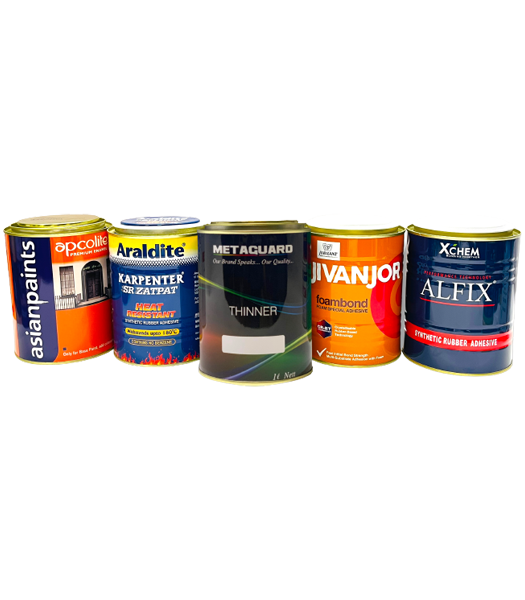 | Tin Containers Tin Containers Deccan Cans & Printers Pvt. Ltd. offers a robust range of Industrial Tin Containers, engineered to provide secure, durable, and... View product → |
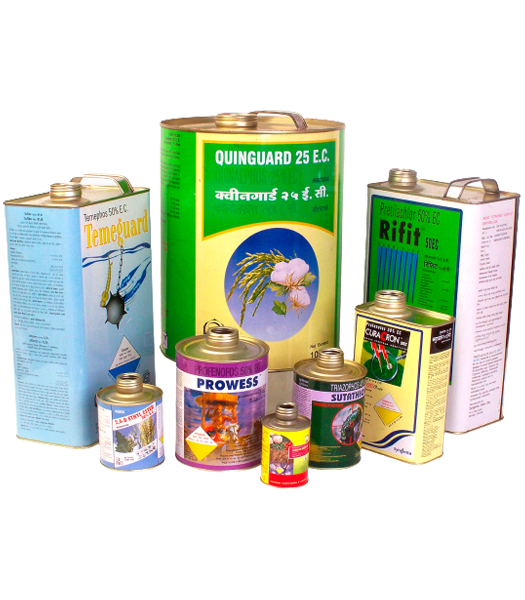 | Tin Containers Tin Containers Deccan Cans & Printers Pvt. Ltd. offers a durable range of Pesticide Tin Containers, designed for reliable packaging and storage of... View product → |
Frequently asked questions
What does internal lacquer change inside a tin can?
It creates a barrier between the product and tinplate on the body, ends, and coated seam areas. The barrier only works when the film remains continuous and bonded.
Which product chemistries attack lacquer or tinplate?
Acids, alkalis, salts, solvents, oxidisers, sulphur compounds, and products with aggressive pH can attack the coating or exposed metal. Temperature, concentration, contact time, and headspace also affect the result.
How can you tell whether corrosion began in the product or the can?
Map corrosion against scratches, seams, exposed edges, and coating holidays, then compare affected cans with retained product samples and unfilled control cans. Check whether the product chemistry changed during storage.
How do you prove lacquer compatibility before releasing a fill?
Test the finished can with the actual product at its highest concentration and intended storage temperature, then inspect coating adhesion, blistering, staining, pinholes, rust, and product contamination over the planned shelf-life interval.