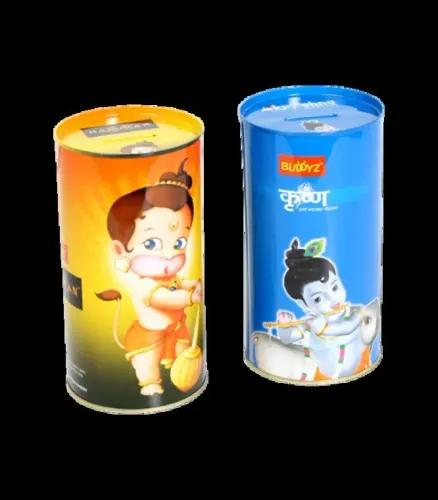

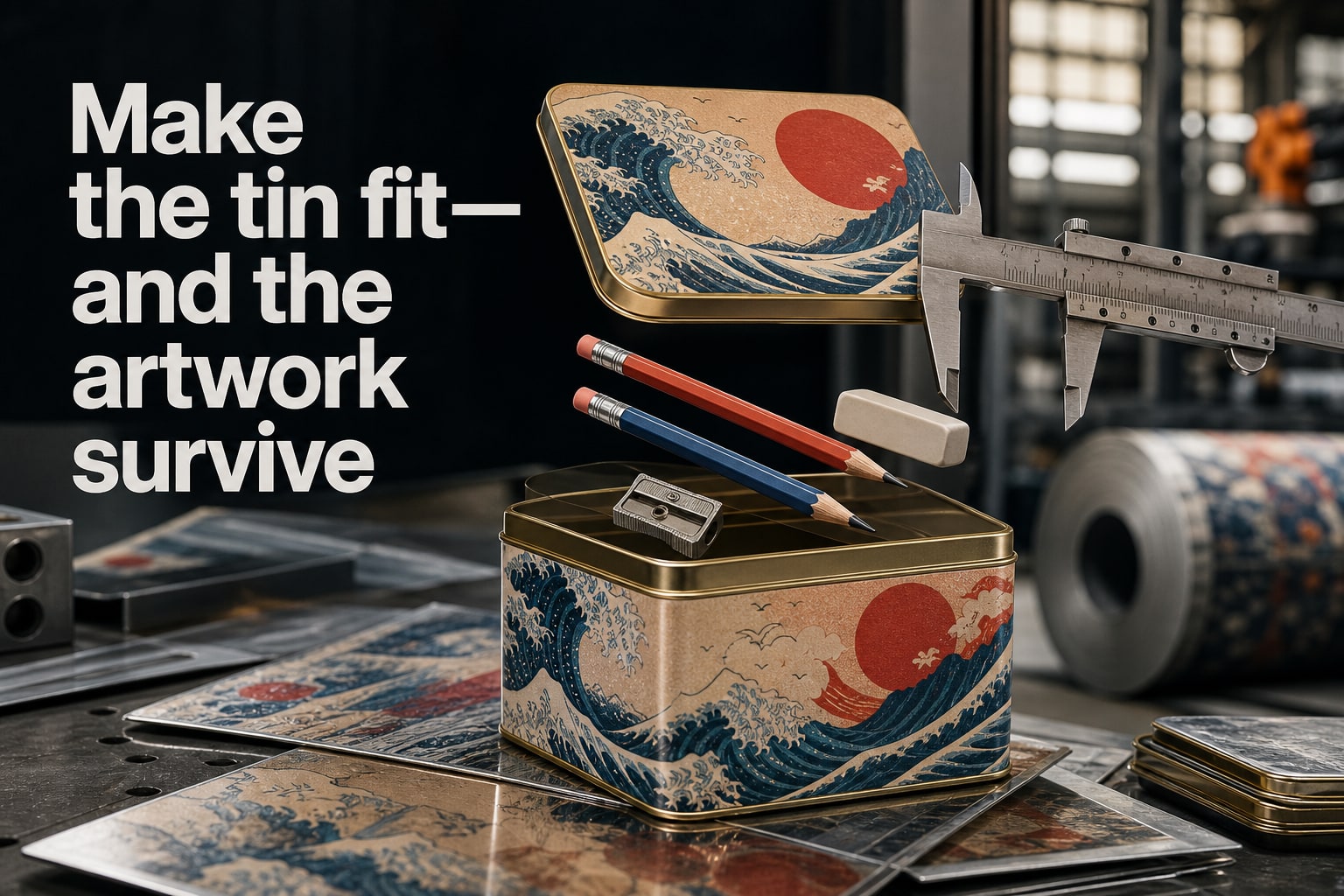
A stationery tin succeeds only when the product fits the usable interior, the lid survives repeated handling, and the artwork accounts for seams, radiused corners and metal-specific printing. By the end, you will be able to match a can format to your stationery product, prepare a production-ready print brief and test samples before approving a batch.
Key takeaways
- Measure the packed stationery before fixing tin dimensions.
- Match the opening style to how customers will reuse the tin.
- Specify artwork tolerances, colours and finishing for metal printing.
- Approve fit, durability and batch samples before the full run.
Match the tin to the stationery product and its packed size
Printed tin cans suit stationery that benefits from protection, gifting or reuse: pencils, pens, markers, premium writing sets, erasers, sharpeners, clips, notebooks and craft supplies. Choose the dimensions from the packed product, not the label “custom tin cans.”
- Measure the longest item, then add clearance for the protective sleeve, paper wrap or divider.
- Record each pencil, pen or marker’s diameter; record eraser, sharpener and clip stack height, plus the quantity per tin.
- Specify finished external dimensions, usable internal dimensions and lid overlap as three separate figures.
- Add headspace for easy removal, lid movement and any desiccant sachet. Use an inner sleeve or paper wrap for easily abraded items; add desiccant when moisture-sensitive contents enter storage, after confirming it suits the product.
| Product | Suitable tin fit |
|---|---|
| Pencils, pens and markers | Rectangular body; internal length exceeds the longest item |
| Premium writing sets | Compartmented rectangular body with sleeve and deliberate headspace |
| Erasers and sharpeners | Compact rectangular or round body sized to the stack height |
| Clips | Round or shallow body; allow loose movement without seam entrapment |
| Notebooks | Flat rectangular body; measure closed thickness and page-edge clearance |
| Craft supplies | Larger body with dividers; measure the tallest component and total quantity |
A nominal size such as 100 × 70 × 25 mm does not reveal usable volume: steel thickness, corner radius, seams and closure clearance consume space. Test a finished sample with the actual products, sleeve and desiccant, not a paper drawing.
That physical check prevents tin packaging from crushing contents, jamming the lid or leaving unusable voids.
Choose the metal, shape and opening style for the buying experience
Specify the substrate, body geometry and closure—not just dimensions. Tinplate is low-carbon steel coated with tin; the steel supplies strength, while tin improves corrosion resistance and printability. Tin-free steel instead uses an electrolytic chromium coating, so do not describe it as tinplate in a tin packaging brief.
Printed metal cans and branded metal tins usually use these choices:
| Option | Best fit | Buying experience and trade-off |
|---|---|---|
| Rectangular body | Notebooks, pencil sets, flat craft items | Efficient packing and stacking; corners need protection from dents and coating damage |
| Round body | Clips, erasers and promotional formats | Distinctive handling, but wastes space around rectangular products |
| Friction-fit slip lid | Frequent, quick access | Low tooling complexity and cost; fast opening, but retention depends on closure force |
| Hinged lid | Gift packs and refillable sets | Lid stays attached and opens quickly; adds tooling and hardware cost |
| Screw lid | Small round formats needing secure retention | Strong retention and refillability; slower access and higher tooling cost |
| Separate lid-and-base | Standard retail and promotional packs | Simple, economical construction; the loose lid can separate during transport |
Set closure force as a functional requirement. Excessive interference makes opening difficult or deforms the body; insufficient interference lets the lid loosen in transit. A friction-fit lid is not automatically airtight or moisture-proof.
Specify protection against crushing, dust and abrasion. Add an inner pack or internal lacquer when:
- Contents are damp, chemically aggressive, stored for long periods or abrade bare steel.
- Validate lacquer adhesion, cure and abrasion resistance; exterior varnish is not a substitute.
Write an artwork and decoration brief that survives metal printing
Request the supplier’s dieline before finalising artwork for printed metal cans. Mark panel boundaries, seams, bend lines, corner radii, embossing and debossing zones, then define:
- CMYK or named spot colours with Pantone references
- Bleed, safe areas, and the supplier’s minimum positive and negative feature sizes
- Artwork orientation and barcode placement
- A white base coat where opaque, bright graphics are required
- Varnish type and approved matte or gloss level
Keep small type, logos and barcodes away from seams and radiused corners. A radius can distort lettering; a seam can interrupt a barcode or shift registration. Direct lithography transfers ink from a plate through a rubber blanket to the metal, so approve trapping and print-to-form allowances with the supplier.
| Decoration | Strength | Trade-off |
|---|---|---|
| Direct lithography | Consistent branded metal tins at suitable volume; durable varnish protects the surface | Tooling and setup increase cost, with a higher minimum order |
| Laminated-sheet printing | Printed sheet gives controlled colour and consistent coverage before forming | Material and forming costs increase; scratches or delamination must be checked |
| Labels | Lowest barrier for short runs and artwork changes | Visible material boundary, weaker premium appearance, and possible edge lifting |
Approve a physical press proof or production sample, never only a PDF or paper proof. Record the substrate, white-coat coverage, ink system, colour references, varnish, gloss, registration tolerance and cosmetic limits because metal reflectivity changes the result. These controls also distinguish durable custom tin cans from lightly labelled printed metal cans.
Test fit, durability and batch consistency before release
A tin is ready for release only after the actual stationery fits the finished sample and survives handling. Record usable internal dimensions, lid clearance, closure force, and interference at corners, seams, or formed areas.
| Check | Test | Release evidence |
|---|---|---|
| Fit | Pack pencils, pens, clips, sharpeners, or craft components in the finished sample | No forced loading, trapped items, seam interference, or unusable space |
| Opening | Cycle refillable premium writing-set lids repeatedly | No lid loosening, body deformation, sharp edges, or coating wear |
| Transport | Drop the packed tin at a height and orientation suited to its product and route | No unacceptable dents, rattle, shifted contents, or lid separation |
Run your fingers and a visual inspection along the interior. Pencils, pens, clips, and craft components must not abrade the steel or migrate into a seam; add an internal lacquer when contents retain moisture, contain aggressive chemicals, abrade bare steel, or face long storage. Exterior varnish is not a substitute.
For Dahej or other humid coastal-industrial storage, keep cartons dry, covered, off wet floors, separated from walls, and protected from condensation, salt exposure, and abrasion. Inspect cartons and tins for water, salt, scratches, forming damage, and cut-edge corrosion.
Approve a physical production sample, not only a PDF. Lock these references:
- Substrate, white-coat coverage, ink system, varnish, colour references, gloss, orientation, registration tolerance, and limits for dents, scuffs, and pinholes.
- Compare the first batch with the approved sample for colour drift, wrong panel scaling, insufficient lid clearance, and text or barcode movement across a radius.
Turn the decision into a supplier-ready brief in Dahej
Send a supplier-ready brief, not a reference image. Include:
1. Product drawings or physical samples, item length, diameter or stack height, count per tin, sleeve or wrap details, target external dimensions, usable internal volume, required headspace, body shape, lid style and specified opening force. State whether the pack is refillable, a gift pack, retail unit or promotional item.
2. Add barcode format and placement, colour references, finish and gloss level, embossing or debossing zones, window cut-outs, artwork orientation and internal lacquer requirements. These details prevent a nominal size from being quoted without enough room for the actual stationery.
3. Request the tooling charge, minimum order quantity, lead-time stages, physical proof process, production tolerances and transport-test method. Ask how the supplier will measure closure force and validate lid retention on the final tooling.
Include annual quantity and required delivery batches, because one large run and several staged deliveries create different cost and storage decisions.
Deccan Cans & Printers Pvt. Ltd. can be included when comparing Dahej-area supply options, but judge custom tin cans, branded metal tins and other tin packaging by the approved sample, closure performance, print controls and documented construction—not a catalogue image.
Finally, request written confirmation that the finished pack is not represented as hermetic, airtight or moisture-proof unless the exact closure and construction have been tested.
Related product
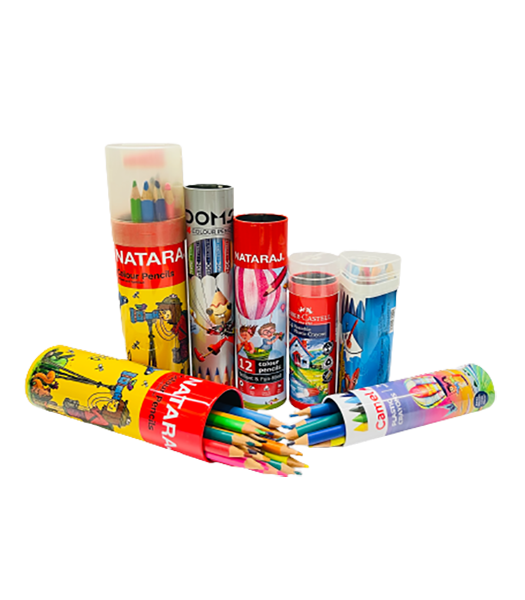 | Tin Containers Tin Containers Deccan Cans & Printers Pvt. Ltd. offers high-quality tin containers for stationery packaging, designed to provide durable, attractive,... View product → |
Frequently asked questions
How do you choose the right tin size for stationery?
Measure the packed product, including sleeves, trays and protective inserts, then add clearance for easy removal without excessive movement.
Which metal, shape and opening style suit stationery tins?
Choose the metal thickness, profile and lid style according to product weight, stacking needs, shelf presentation and whether customers will reuse the tin.
What belongs in a printed tin artwork brief?
Specify dimensions, dielines, colour references, artwork placement, finish, text legibility and allowances for seams, corners and metal-printing variation.
What should you test before releasing stationery tin packaging?
Test product fit, lid operation, drop and handling durability, decoration quality, corrosion protection where relevant, and consistency across production samples.