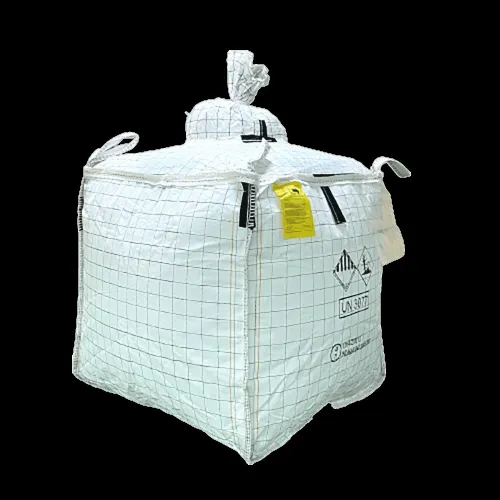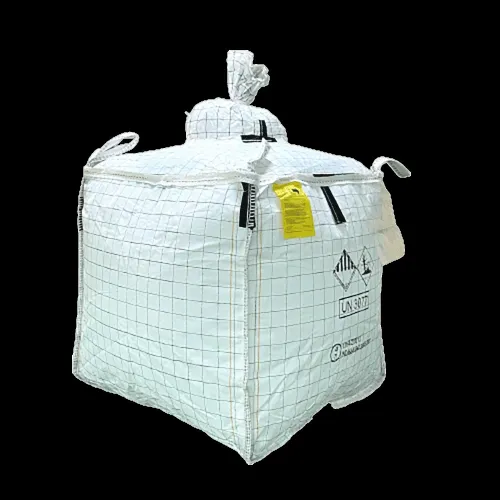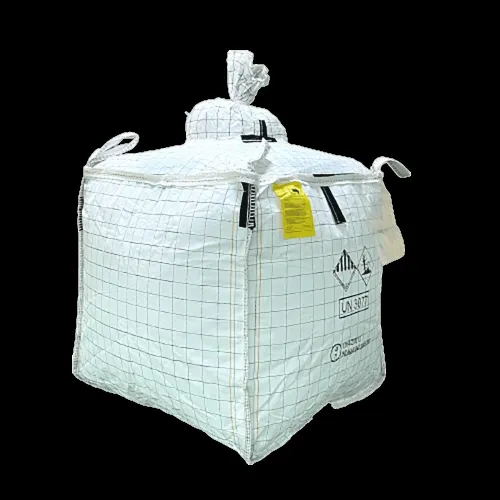

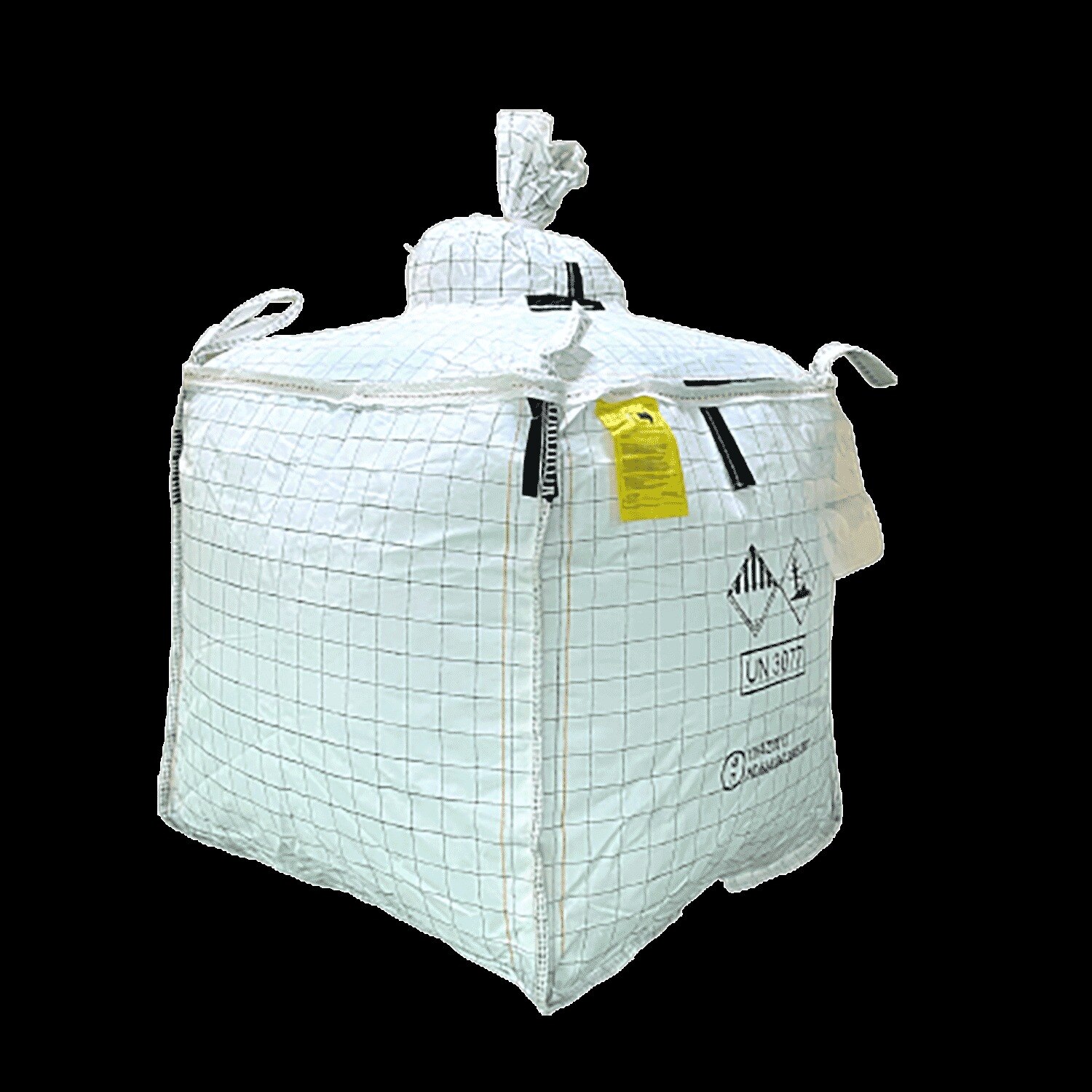
A UN mark on an FIBC identifies a tested packaging design, not automatic permission to carry every hazardous substance. You will be able to read the mark, match the bag to its packing group and material, verify the tested configuration, and set handling controls before filling or shipping it.
Key takeaways
- Match the FIBC to the substance, packing group and static-control requirement.
- Confirm the certificate covers the exact bag design, closure and gross mass.
- Follow the tested bag’s limits for filling, lifting, stacking and discharge.
- Specify the finished UN FIBC before comparing supplier quotations.
What the UN mark on an FIBC actually approves
A UN FIBC marking approves a tested flexible-IBC design, not every hazardous substance or every version of the bag. Its regulatory basis is the UN Recommendations on the Transport of Dangerous Goods. The approval is limited by the marked construction, closure, performance level, maximum gross mass and applicable dangerous-goods packing instruction.
The woven-plastic code identifies the bag’s construction:
| Code | Construction |
|---|---|
| 13H1 | Uncoated fabric, without liner |
| 13H2 | Coated fabric, without liner |
| 13H3 | Uncoated fabric, with liner |
| 13H4 | Coated fabric, with liner |
Packing Group I means high danger, Group II medium danger and Group III low danger. X covers Groups I, II and III; Y covers Groups II and III; Z covers Group III only.
Read the complete UN FIBC marking rather than stopping at the word “UN”:
- The UN packaging symbol shows conformity with UN design-type marking requirements.
- The code, such as 13H3, identifies construction; X, Y or Z identifies the approved packing-group range.
- The maximum gross mass is the legal total for product, bag, liner and attached components. It is not the bag’s nominal volume or payload.
- “S” identifies solids; a test pressure appears where that marking is applicable.
- The manufacturing date, approval or certificate number, and manufacturer identification complete the traceability record.
A model to inspect is UN 13H3/Y/.../S/.../date/.../manufacturer. Treat every field as part of the approval, and compare it with the certificate and finished bag.
Match the bag to the substance, packing group and static risk
A hazardous-material label does not identify a suitable FIBC. Match the bag to the substance’s proper shipping name, UN number, physical form, Packing Group I, Packing Group II or Packing Group III, dangerous-goods packing instruction and transport mode.
Check these points before selecting the design:
- Flexible IBC approval is primarily for solids, powders and granules. A flexible-IBC marking does not authorise liquids or slurries; liquid service needs packaging approval covering leakproofness and closures.
- UN transport approval is separate from safe working load, 5:1 or 6:1 safety factor, fabric strength, UV resistance and liner choice.
- Nominal volume is geometric capacity, not payload. The legal limit is maximum gross mass, including product, bag, liner and attached components. Bulk density and uneven loading can make the nominal capacity unusable.
| Approval or control | What it covers | What it does not prove |
|---|---|---|
| UN design-type approval | Marked substance range, performance level, construction, closure, gross-mass limit and packing instruction | Electrostatic suitability |
| Type A FIBC | No deliberate static-control feature | Protection for flammable service |
| Type B FIBC | Limits propagating brush-discharge risk under defined conditions | A general approval for every dust or vapour |
| Type C FIBC | Conductive construction requiring Type C FIBC grounding | Safe operation without verified earth continuity |
| Type D FIBC | Dissipative design intended to avoid grounding connections | Compatibility with every ignition hazard |
Assess minimum ignition energy, solvent vapour and dust hazards separately from UN approval. For flammable or combustible service, verify earth continuity during filling and emptying; a clip on an isolated or nonconductive point is inadequate. Set written grounding and bonding procedures before use.
Verify that the certificate covers the bag you will receive
A printed UN mark is not enough. Request the UN test report or certificate, then compare it with the production specification for the bags being delivered. Approval belongs to a complete design type, not to a brand, model family or fabric grade.
Check every field:
- 13H code, exact fabric and coating
- Liner material and thickness
- Bag dimensions and maximum gross mass
- Inlet, outlet and their geometry
- Closure method and compatibility
- Lifting-loop arrangement and sewing pattern
- Approved filling equipment, stacking arrangement and reuse restrictions
13H3 means uncoated woven plastic with a liner; 13H4 means coated woven plastic with a liner. Changing the liner, coating, closure or seam can move the finished bag outside its tested design type.
The documentation should identify these tests and their acceptance results:
| Test | What to verify |
|---|---|
| Top-lift test | No rupture, dangerous deformation or loss of containment |
| Stacking test | Approved load tied to the marked maximum gross mass |
| Drop test | No leakage or damage affecting safe transport |
| Tear, topple and righting tests | No failure that compromises containment or handling |
| Cyclic compression test | No unacceptable damage after repeated loading |
Also confirm sift-proof seams and closure compatibility. A fabric tensile-strength certificate, safe-working-load statement, 5:1 or 6:1 safety factor is not UN design-type approval. Verify that the certificate permits the intended stacking load, repeated transport or reuse; do not infer any of these from denier or nominal capacity.
Fill, lift, stack and discharge the bag without creating a new hazard
Use the certificate and bag marking as the operating limits, not fabric strength or appearance alone.
1. Before filling, perform FIBC inspection. Check the label for legibility, then examine the fabric, seams, lifting loops, liner, inlet and outlet for cuts, abrasion, contamination, UV damage or other deterioration. Quarantine any bag that fails.
2. Confirm the product, packing configuration, liner fit, filling method and FIBC filling limits. The marked maximum gross mass includes the product, bag, liner and attached components.
3. Fill evenly and keep the bag stable. Do not exceed the marked maximum gross mass, overfill to nominal volume, or force material into a closed outlet.
4. Use only the designated lifting loops with the approved lifting frame for safe lifting. Do not drag the bag, lift it from the liner, tie points or discharge spout, or place forklift tines against the fabric.
5. Stack only in the arrangement supported by the certificate and marked maximum gross mass. A cyclic compression test does not authorise a different stacking pattern; denier, a 5:1 or 6:1 safety factor, and a supplier’s unverified statement do not establish stacking height.
6. Secure bags against movement during transport. Store them away from moisture, sunlight, sharp edges and incompatible chemicals.
7. During discharge, control dust, keep personnel outside the load path, and connect a Type C bag to a verified earth point when required. Stop work and isolate any damaged or contaminated bag.
8. Check the certificate and dangerous-goods rules for the shipment mode and jurisdiction before reuse. Confirm whether the bag is single-trip only or requires periodic and exceptional inspection.
Specify the finished UN FIBC before requesting a quotation
Put the finished design in a UN-certified FIBC specification before asking for a quotation. Start with the cargo and approval basis:
1. State the substance’s UN number, proper shipping name, physical form, packing group, transport mode and dangerous-goods packing instruction. Add the required performance level, X, Y or Z, maximum gross mass and packaging code, such as 13H3 or 13H4.
2. Describe the construction precisely: fabric coating; liner material and thickness; liner compatibility; dimensions; top and bottom construction; inlet and outlet closures; lifting-loop arrangement; sift-proof seams; stacking arrangement; discharge equipment; and static-control classification. A 5:1 or 6:1 safety factor does not replace UN approval.
3. Require FIBC manufacturer documentation identifying the certificate or test-report number, manufacturing-site identification, approved configuration, maximum gross mass and any single-trip or reuse restriction. Ask how the stated stacking arrangement relates to the tested design; denier alone proves nothing.
4. Require a production sample or dimensioned drawing that matches the certificate. Do not accept a similar bag from the same product family: a changed liner, closure, coating or seam can invalidate the design approval.
A manufacturer serving industrial buyers, such as Deccan Cans & Printers Pvt. Ltd., can add value by translating the approved design into your actual liner, closure, loop and discharge arrangement. The certificate remains decisive; accept customization only when the changed configuration stays within the tested approval.
Related product
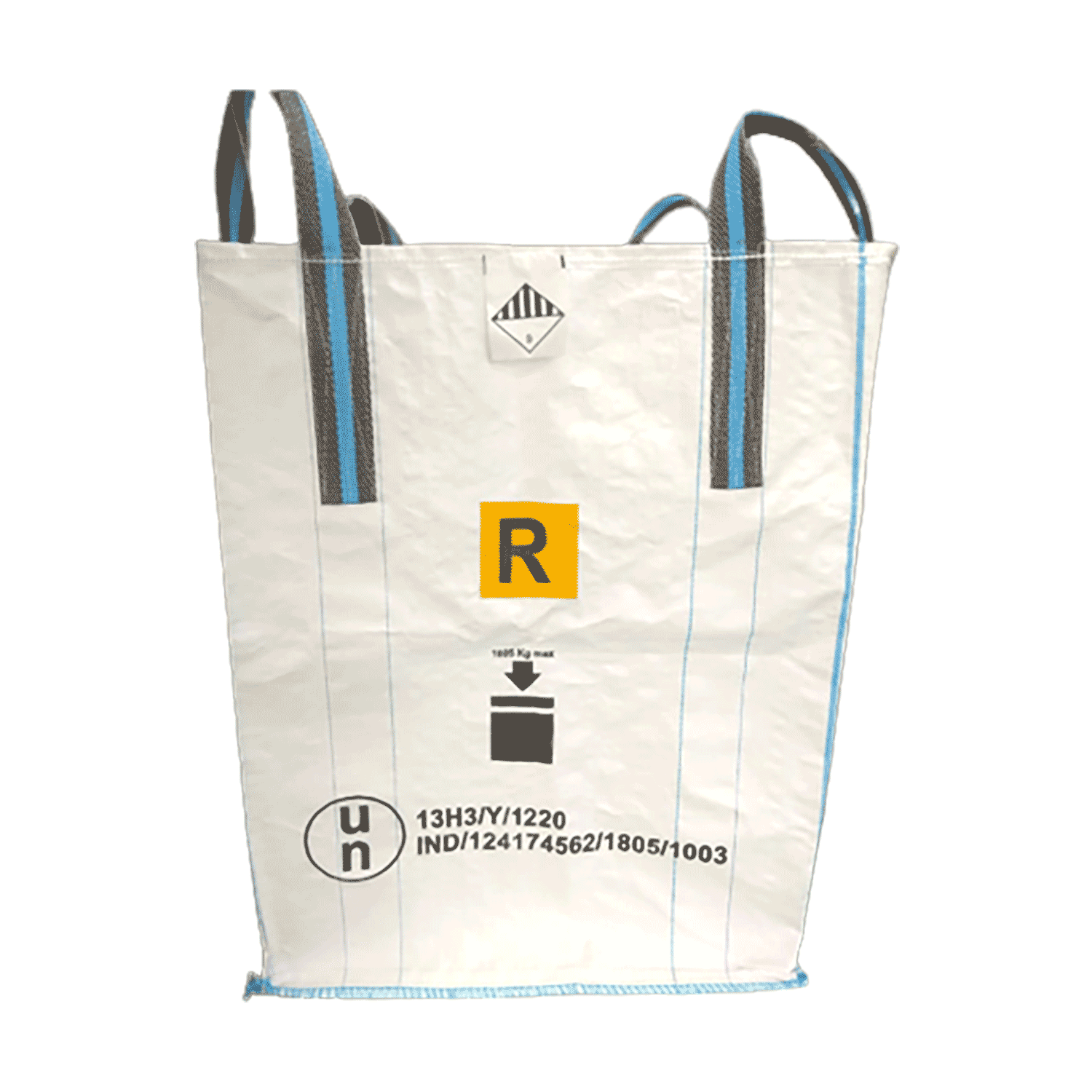 | FIBC Section Un Bags UN Certified Bulk Bags – Rigorous Performance Testing for Safety & Reliability Deccan UN Certified Bulk Bags are specially engineered for the safe... |
Frequently asked questions
What does the UN mark on an FIBC approve?
It approves a tested flexible-IBC design, with limits for construction, closure, performance level, maximum gross mass and packing instruction.
How do you match a UN FIBC to hazardous material?
Check the substance, its dangerous-goods classification, packing group and static risk before selecting the bag design.
How can you verify a UN FIBC certificate?
Compare the certificate with the exact bag you will receive, including its construction, closure, performance level and maximum gross mass.
How should you handle and discharge a UN FIBC safely?
Stay within the tested fill, lift and stacking limits, and control static during filling and discharge.