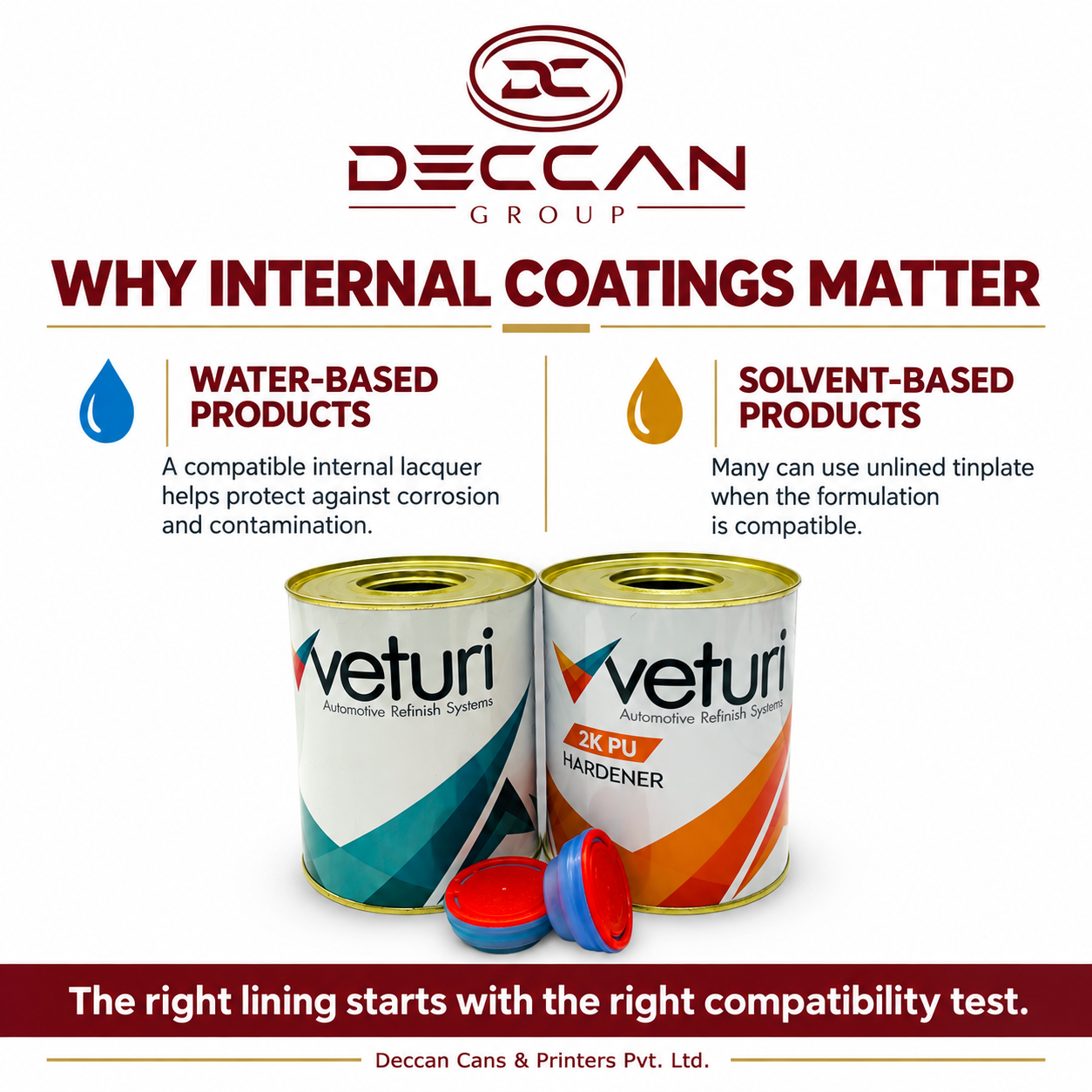
What’s inside your metal can matters as much as what’s printed outside.
For paints, coatings and chemical products, the right internal finish helps protect both the packaging and its contents.
WHY WATER-BASED PRODUCTS NEED INTERNAL COATINGS
Water, dissolved oxygen and salts can promote corrosion when a formulation comes into contact with exposed metal. The product’s pH and additives can also influence how it reacts with the can.
A suitable internal lacquer creates a protective barrier between the product and the metal. This helps:
• Reduce internal rust and corrosion.
• Prevent contamination from corrosion products.
• Protect the product’s colour, consistency and quality.
• Maintain packaging integrity during storage.
For water-based paints and similar formulations packed in steel or tinplate cans, a compatible internal coating is therefore an important part of packaging selection.
WHY MANY SOLVENT-BASED PRODUCTS USE UNLINED CANS
Many low-moisture, non-corrosive solvent-based formulations are compatible with plain tinplate and can be packed without an internal lacquer.
However, “solvent-based” does not automatically mean “no lining required.” Certain formulations may need a specialised coating, while some solvents can soften or attack an unsuitable lacquer.
THE RIGHT CHOICE DEPENDS ON YOUR FORMULATION
The decision should consider the complete formulation, moisture content, storage conditions and intended shelf life. Compatibility testing with the actual product and the complete can—including its closure—is essential before commercial filling.
At Deccan Cans & Printers Pvt. Ltd., we understand that effective packaging starts with the product it needs to protect.
Contact us to discuss metal packaging for your paints, coatings and chemical products.