A container that holds one solvent-based paint can fail when its lacquer softens, its gasket swells or its closure loses vapour tightness. By matching the formulation, coating, capacity, closure and transport documentation, you can issue a purchase specification that separates a suitable tinplate pack from one that only looks industrial.
Key takeaways
- Test formulation compatibility before choosing unlined tinplate.
- Match can shape, capacity and closure to viscosity and dispensing needs.
- Check lining, corrosion resistance and seal performance during storage tests.
- Request hazardous-goods approval documents and transport markings before shipment.
Start with the formulation, not the word “industrial”
A solvent-borne paint based on mineral spirits, or a mineral-oil lubricant without aggressive additives, can suit an unlined tinplate can after compatibility testing. Water, acids, alkalis, amines, ketones, esters and strong additives increase the risk of corrosion, swelling, odour transfer or lining failure. Do not approve paint packaging from the word “industrial” alone.
| Formulation | Suitable container | What to verify |
|---|---|---|
| Hydrocarbon solvent paint with low water content | Unlined or lined tinplate | Rust at seams, colour change and solvent loss |
| Water-based paint, acidic or alkaline chemical | Epoxy- or phenolic-lined tinplate | Blistering, adhesion loss and corrosion |
| Mineral oil or grease with mild additives | Often unlined tinplate | Additive attack, sludge and seal swelling |
| Solvent-rich lubricant or chemically active additive package | Lined tinplate or another compatible material | Softening, permeation and gasket compatibility |
Phenolic linings suit many oils and solvents; epoxy linings can offer broader resistance, including some water-based formulations. Neither is universal. Check the solvent system, pH, water content, additives and maximum storage temperature against the coating supplier’s data.
Run a filled-pack test using the actual product, can, closure and gasket at the expected temperature. Inspect the liquid and the can for rust, coating lift, pinholes, sediment, odour or colour transfer. That evidence establishes tinplate compatibility and determines whether unlined or lined lubricant containers are safe for the intended shelf life.
Match capacity, shape and closure to the product
Specify the pack around the product’s flow and filling method, not a catalogue number. Compare can capacities using both nominal filling volume and brimful capacity: a “20-litre” can still differ in usable fill, headspace, and gross weight. Leave room for filling tolerance and thermal expansion.
| Product | Suitable format | Sealing system |
|---|---|---|
| Paints | Round or rectangular open-head can for viscous products | Lever-lock lid with gasket; use a wide opening for manual filling and stirring |
| Solvents | Round tight-head can with minimal internal dead space | Tight-head closure with plug-and-cap or screw-cap assembly; select a gasket that resists the solvent |
| Oils | Round or rectangular tight-head can | Screw cap, ROPP closure, or plug-and-cap assembly with a positive seal |
| Greases | Wide-mouth open-head pail or can | Removable lid with gasket; choose the opening for scooping or pump filling |
Specify steel thickness, seam or weld construction, and the internal lacquer separately from the word “tin.” Test the actual formulation in the complete pack at the expected storage temperature; a lining that survives the base liquid can still soften when additives or solvents are present.
- For flammable liquids, leak-test the body, seam, closure and gasket after handling and transport.
- Check gasket swelling and seal recovery in the actual solvent system.
- Confirm that repeated opening and resealing does not damage the sealing surface.
Prevent corrosion, coating failure and contamination in storage
A filled can fails when its steel, lining and storage conditions do not match the formulation. Tinplate is low-carbon steel with a thin tin layer; the steel supplies strength, while tin and the internal lacquer resist attack. Specify steel thickness, tin-coating designation, seam construction and lining instead of ordering a generic “tin” can.
| Material or lining | Protection offered | Check before approval |
|---|---|---|
| Tinplate | Tin protects exposed steel and supports an unlined or lined pack | Confirm the formulation will not penetrate damaged tin or attack seams |
| Tin-free steel | Chromium-based surface protects the steel before an organic lining is applied | Require a compatible internal coating; do not treat it as automatically corrosion-proof |
| Epoxy coating | Strong barrier against many water-based and chemical formulations | Test solvent resistance, adhesion and softening at the maximum storage temperature |
| Phenolic coating | Useful barrier for selected oils, solvents and aggressive contents | Check for odour, colour transfer and loss of adhesion with the actual product |
Run a filled-pack compatibility test, not a resin-only test. Use the actual formulation, can, closure and headspace at the intended storage temperature; inspect for rust, blistering, swelling, pinholes, staining, odour and coating flakes.
- Keep cans upright, sealed and under cover; rain, condensation and wet floors attack seams and exposed steel.
- Store away from direct sun and heaters, because heat accelerates solvent attack and pressure from expansion.
- Keep incompatible chemicals segregated so a spill cannot contaminate closures or labels.
- Rotate stock by batch and quarantine cans with bulging, leaking, dented seams or loose closures.
Verify hazardous-goods approval and transport markings
Do not approve a can for flammable paint or chemicals because it carries a UN symbol. UN certification applies to a defined packaging design and performance level, not to every product that fits inside it.
1. Request the UN packaging certificate and confirm the approved packaging type, tinplate construction, capacity, closure, gasket, packing group and product category. Packing groups I, II and III indicate increasing tolerance for transport hazards; the certificate must cover the group assigned to your substance.
2. Check that the production can matches the tested design exactly. A different lid, seam, liner, gasket material or fill capacity can invalidate the approval even when the body looks identical.
3. Ask for performance-test evidence covering the required tests, including the drop test and leakproofness test. The approval file can also include stacking, hydrostatic pressure and permeability results. Check the test pressure or maximum gross mass where the mark specifies one.
4. Read the permanent UN mark on the can. It should identify the UN packaging symbol, packaging type and material, performance level, manufacture year, approving country and manufacturer or certification identifier. Missing or conflicting marks create a traceability failure.
5. Coordinate transport marking with the product’s safety data sheet, dangerous-goods classification and carrier rules. For retail or packaged commodities in India, separately verify net quantity, packer details, and month and year of packing under the Legal Metrology (Packaged Commodities) Rules.
Turn the purchase enquiry into a testable Vadodara specification
Do not approve a quotation that says only “industrial tin can.” For tin containers in Vadodara, make the supplier checklist measurable: material, dimensions, lining, closure, testing, markings and delivery records must appear in the purchase specification.
1. Confirm the steel thickness, tin-coating designation, body and seam construction, neck or opening dimensions, nominal capacity and fill volume. Ask for the approved drawing, not a catalogue photograph.
2. Name the actual paint, chemical or lubricant formulation, solvent system, water content, acidity or alkalinity, additives and storage temperature. Require compatibility testing with the production can, internal coating, closure and gasket; batch testing must record lining adhesion, corrosion, swelling, odour or colour transfer and leakage.
3. Identify the internal lacquer as unlined, phenolic, epoxy or another named coating. Ask for its technical data sheet and the test duration and temperature used, because a lining that survives the base solvent can still fail after additives are added.
4. Specify the closure type, gasket material, torque or crimp settings and leak-test method. Require the supplier to confirm that the delivered closure matches the tested configuration.
5. For hazardous contents, request the UN performance certificate and mark details for the exact packaging design, capacity, closure and packing group. A UN mark on a similar can is not approval for your product.
6. Approve artwork against the Legal Metrology Packaged Commodities Rules, including net quantity, packer details, month and year of packing and required declarations.
Give Deccan Cans & Printers Pvt. Ltd., or any competing supplier, this same signed specification before production and again at delivery; reject substitutions without written approval.
Related product
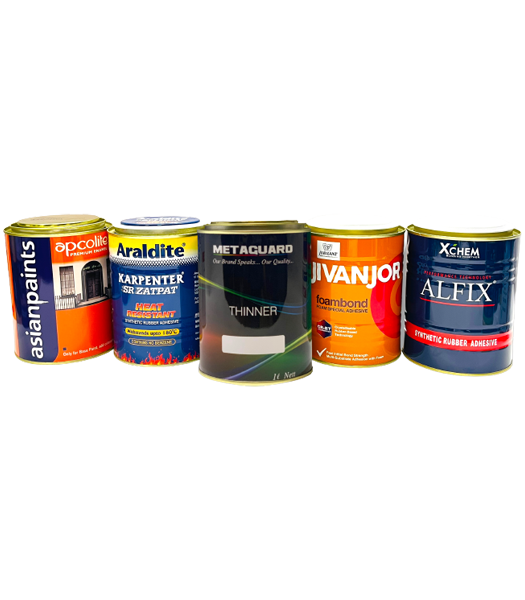 | Tin Containers Tin Containers Deccan Cans & Printers Pvt. Ltd. offers a robust range of Industrial Tin Containers, engineered to provide secure, durable, and... View product → |
Frequently asked questions
Which paints, chemicals and lubricants suit unlined tin containers?
Solvent-borne paints based on mineral spirits and mineral-oil lubricants without aggressive additives can suit unlined tinplate after compatibility testing. Water, acids, alkalis, amines, ketones, esters and strong additives need closer review.
How do you prevent corrosion, coating failure and contamination?
Test the formulation against the tinplate, internal coating, closure gasket and seam. Check for rust, swelling, odour transfer, discolouration, leakage and lining breakdown during storage at the intended temperature.
What should you verify before transporting hazardous contents?
Request the applicable hazardous-goods approval documents, confirm the container's approved capacity and closure configuration, and check that package markings match the product classification and transport mode.
What information belongs in a Vadodara tin-container enquiry?
Specify the formulation, capacity, dimensions, can shape, filling temperature, closure, gasket, internal coating, storage conditions, handling method, hazardous classification and required transport markings.