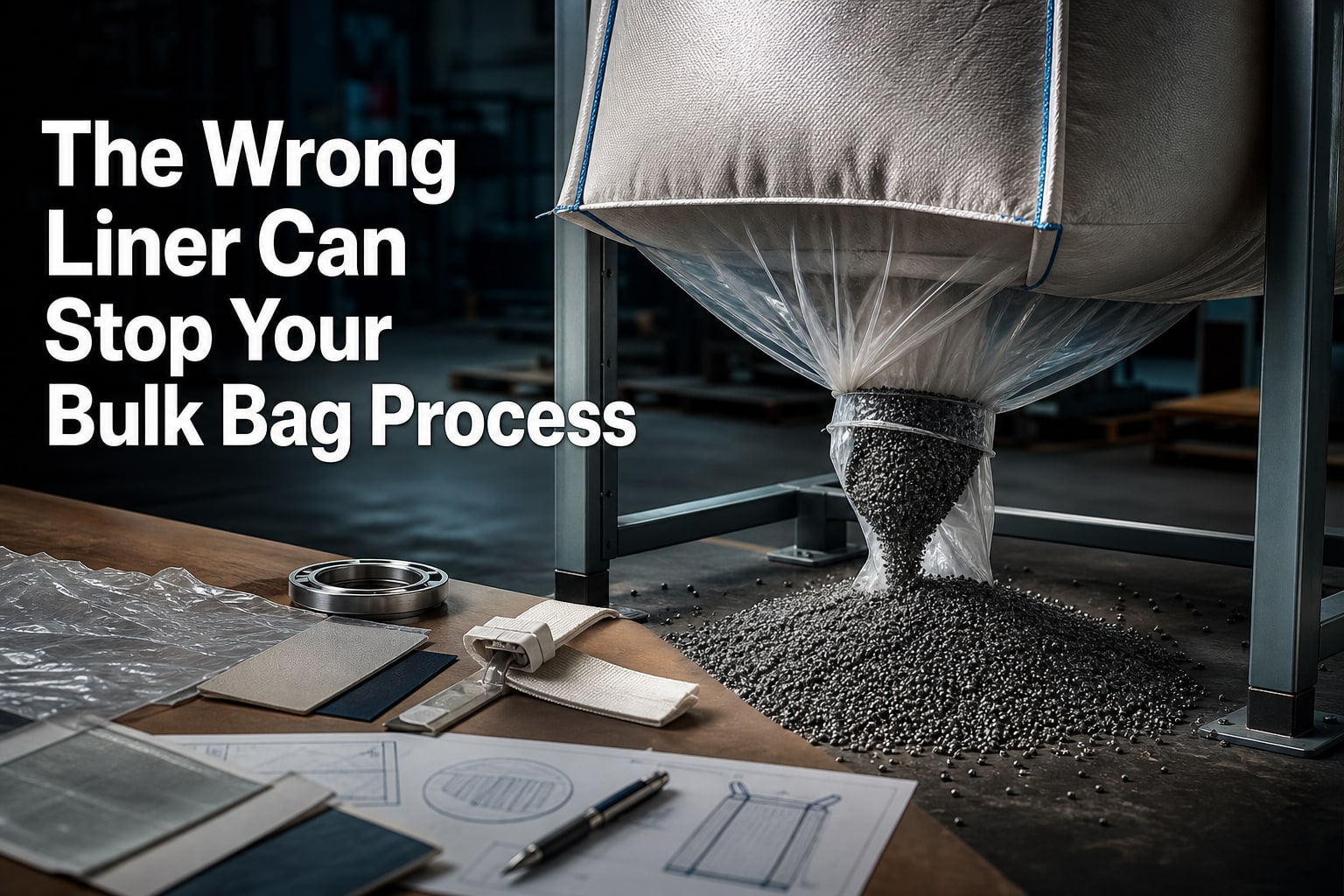
A bag liner must match the material, filling equipment, discharge arrangement, static-control plan and outer FIBC dimensions. By the end, you will have a practical specification for choosing, testing, installing and comparing liners without relying on capacity or price alone.
Key takeaways
- Choose liner material and thickness from product compatibility and barrier needs.
- Confirm liner dimensions against the FIBC body, seams, closures and discharge spout.
- Test filling, discharge flow, liner movement and static controls before approval.
- Request drawings, film specifications, test results and controlled revision records.
Start with the product, process and liner fit
Choose the liner from the product and handling process, not from the nominal capacity of the flexible intermediate bulk container.
A loose liner suits relatively free-flowing products when low cost and easy replacement matter; a form-fit liner suits products that collect in folds or require cleaner, more complete discharge; an attached liner suits repeatable production where installation errors, contamination or liner movement must be controlled.
| Option | What it means | When it applies |
|---|---|---|
| Loose liner | Oversized film liner placed inside the FIBC | Simple filling, low abrasion and products that tolerate some folding |
| Form-fit liner | Dimensionally shaped liner matched to the bag body | Products that bridge, leave residue or risk folding into the outlet |
| Attached liner | Liner fixed to the FIBC at selected seams, inlet or outlet | Repeatable filling and discharge, controlled handling and reduced installation time |
- Record the product’s moisture and oxygen sensitivity, particle size, flow behaviour, chemical compatibility and tendency to bridge or aerate.
- Record the filling method, filling height, discharge method and expected outlet flow. A loose liner can fold into a bottom spout and become the restriction.
- Measure the FIBC body, inlet, outlet, spout length and usable filling height. Match the liner to these dimensions, not just to bag volume.
- State food-contact needs, film thickness, abrasion risk and electrostatic requirements. A standard polyethylene liner insulates the product; grounding the outer FIBC does not ground it, so a Type C system needs a connected conductive or dissipative design.
Match film construction to chemical, barrier and static requirements
A standard polyethylene bag liner is electrically insulating, so grounding the outer FIBC does not ground the product-facing film. Choose resin and layer structure against chemical compatibility, moisture and oxygen sensitivity, particle size, filling energy, discharge method and abrasion risk—not the nominal bag capacity.
| Option | Construction | Best fit and limitation |
|---|---|---|
| Polyethylene | Single-layer or coextruded PE film | General powders, granules and moisture protection; verify compatibility with solvents, oils and aggressive chemicals |
| Polypropylene | PP film or PP-containing multilayer | Higher-temperature handling and selected chemical applications; confirm seal performance and product compatibility |
| Aluminium-barrier | PE or PP bonded to aluminium foil or metallised film | Oxygen, light and strong moisture barriers; foil can crease or crack, while metallised film is not automatically conductive |
| Multilayer | PE or PP combined with barrier or conductive layers | Products needing several controls; require the layer sequence and each layer’s function |
Select thickness from puncture and abrasion exposure. Fine powders need reliable seals more than simply thicker film: request tubular construction where possible, or state longitudinal and bottom seal width, seal type, leak-test method and acceptance limit. Check that filling impact, liner collapse during discharge and repeated handling will not split the film.
Do not accept “antistatic” alone. Request the electrical test method, resistance or charge-decay limit, conditioning humidity and the applicable FIBC electrostatic type. For a Type C FIBC, specify how conductive or dissipative liner components connect to the bag’s conductive elements and groundable tab; an insulating liner can interrupt the intended path.
Include food-contact or pharmaceutical declarations when the product requires them.
Specify dimensions, closures and discharge geometry
A liner that matches only the FIBC’s nominal capacity can still block the outlet. Measure the selected flexible intermediate bulk containers and specify the body length, body width, body height, filling height, inlet position, inlet diameter, outlet position and outlet diameter on a drawing.
Give the supplier one controlled dimensional specification:
- State the liner’s finished length and width, including the allowance needed for corner fit without loose folds.
- Match the top inlet diameter and length to the filling hose, filter, clamp or tie closure. Include the required headspace so the liner does not burst or pull away from the FIBC during filling.
- Specify the bottom outlet diameter, length and position from each bag corner. It must enter the outer discharge spout without twisting, collapsing or folding across the opening.
- Name the closure: heat-sealed, drawstring, tie-off, clamp or a defined combination. A closure that leaves a flap inside the outlet can become the flow restriction.
- Define the outlet seal and attachment method, plus the required open diameter after installation, not merely the nominal tube diameter.
- Request a dimensional drawing and an installed sample checked at full filling height and during discharge.
A loose, oversized bag liner gathers in corners and traps product; an undersized liner tears or pulls against the seams. Products that bridge or aerate need a sufficiently large, unobstructed outlet and a compatible outer discharge spout.
Confirm complete emptying with the actual powder or granule, because the liner—not the woven FIBC—can become the narrowest passage.
Test installation, flow performance and operating safety
Reject a bag liner with pinholes, split seams, damaged closures, visible dirt or a failed leak-test record. Check the liner’s resin, dimensions and retained sample against the approved specification before it enters the filling area; the woven outer body carries the load, but liner damage can release product or contaminate it.
Install in a clean, dry zone with the flexible bulk containers supported and the filling equipment grounded. Open the bag liner without dragging it across the floor, seat the inlet fully, and secure the outlet to the outer spout.
Remove folds at the discharge path: a twisted liner outlet can become the flow restriction and leave residue inside.
Use a controlled trial with the actual product and normal equipment settings. Record fill rate, dust escape, pressure or aeration behaviour, discharge time, bridging, liner movement and the mass left behind. Stop if the liner balloons, blocks the outlet, leaks or creates a static discharge.
- Sample the first and last filled containers for foreign matter, moisture pickup and product carryover.
- Measure static performance using the stated test method, resistance or charge-decay limit, conditioning humidity and FIBC electrostatic type; “antistatic” alone proves nothing.
- For combustible dust, assess minimum ignition energy, minimum ignition temperature, explosibility, conveying, grounding and discharge equipment together. Type C or Type D is not a universal remedy.
- Price cleaning, slower filling, double handling, liner disposal and rejected product alongside the liner price. A cheaper liner that restricts flow can cost more per usable tonne.
Give suppliers a controlled specification and verify the documents
Approve production only after the supplier’s quotation becomes a controlled specification, not a price and a bag GSM. Ask fibc manufacturers in bangalore and fibc suppliers in bengaluru for the following records:
- Resin grade, layer structure, nominal thickness and thickness tolerance
- Finished liner length, width, inlet, outlet, spout alignment and seal type
- Leak-test method, acceptance limit, test result and retained sample from the quoted lot
- Food-contact or pharmaceutical declarations when the product requires them
- Electrostatic classification, test method, resistance or charge-decay limit, conditioning humidity and bonding method to the FIBC
- Drawing, revision number, batch or lot identification, certificate of analysis and change-notification procedure
“Antistatic” alone proves nothing. For a Type C FIBC, confirm that the liner does not interrupt the conductive path from the product region through the bag’s conductive elements to the groundable tab. Deccan Cans & Printers Pvt. Ltd. can be evaluated on the same document set as any other supplier, rather than on product labels.
Compare the approved lined flexible intermediate bulk containers with realistic alternatives before releasing a purchase order:
| Option | Main advantage | Main limitation | Choose it when |
|---|---|---|---|
| Lined FIBC | Barrier and contamination control with bulk handling | Liner can restrict flow or affect grounding | Moisture, dust or gas protection matters |
| Unlined FIBC | Lowest liner complexity | No internal barrier | Material tolerates ambient exposure |
| Rigid drum | Strong containment and stacking | More storage space and handling effort | Leakage or impact risk dominates |
| Woven sack | Simple filling and low handling weight | Limited barrier and poorer dust control | Product is robust and non-hygroscopic |
Run a filled pilot, inspect discharge, and approve against the signed specification. Reject substitutions without a documented change review.
Related product
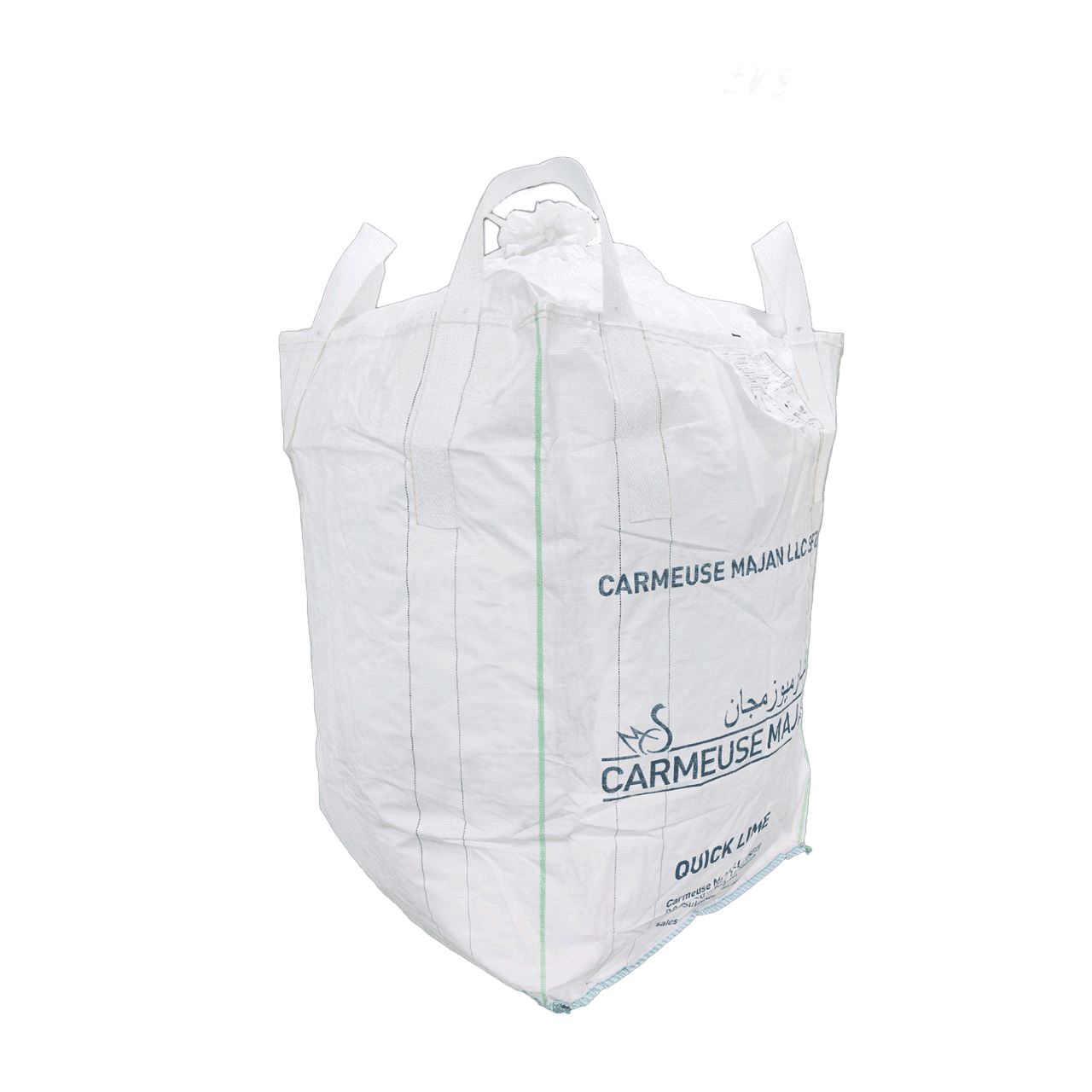 | FIBC Section Bags With Liners FIBC Liners – Bulk Bag Liners Deccan Cans & Printers Pvt. Ltd. |
Frequently asked questions
How do you choose the right liner for a flexible intermediate bulk container?
Start with the product and process: identify chemical compatibility, moisture and oxygen exposure, filling method, discharge method, temperature, and static-control needs before selecting the liner.
Which liner film construction suits chemical and barrier requirements?
Compare polyethylene film type, thickness, coextruded layers, antistatic treatment, conductivity and barrier performance against the product’s chemical, moisture, oxygen and static risks.
What liner dimensions and closures should you specify?
Specify the liner’s flat width, length, gusset size, top attachment, filling inlet, discharge outlet, tie or heat-seal closure, and outlet position using a drawing tied to the FIBC dimensions.
How should you test an FIBC bag liner before production use?
Install the liner in a production-equivalent container, then test filling, liner fit, product flow, discharge, air removal, seam integrity and static-control procedures.
What documents should you request from a liner supplier?
Request the controlled specification, dimensional drawing, film structure and thickness, compatibility information, test results, material traceability, closure details and revision history.