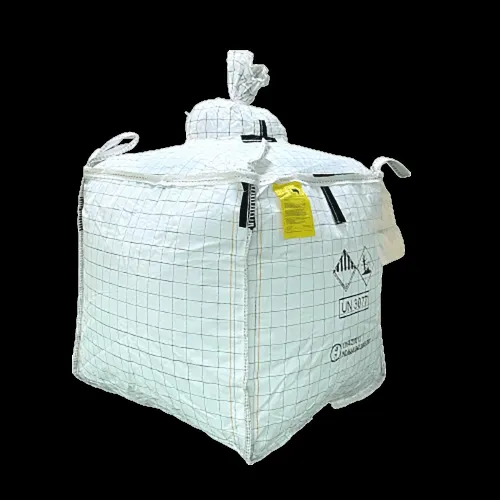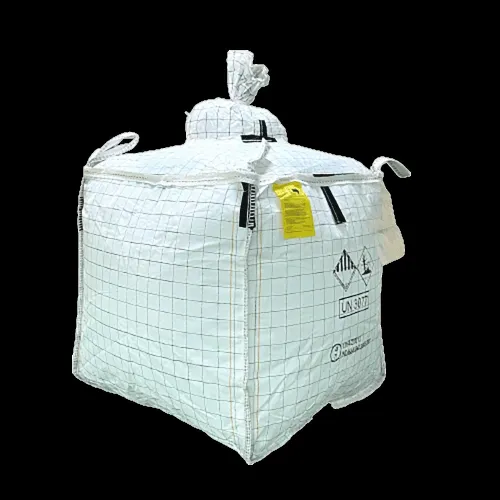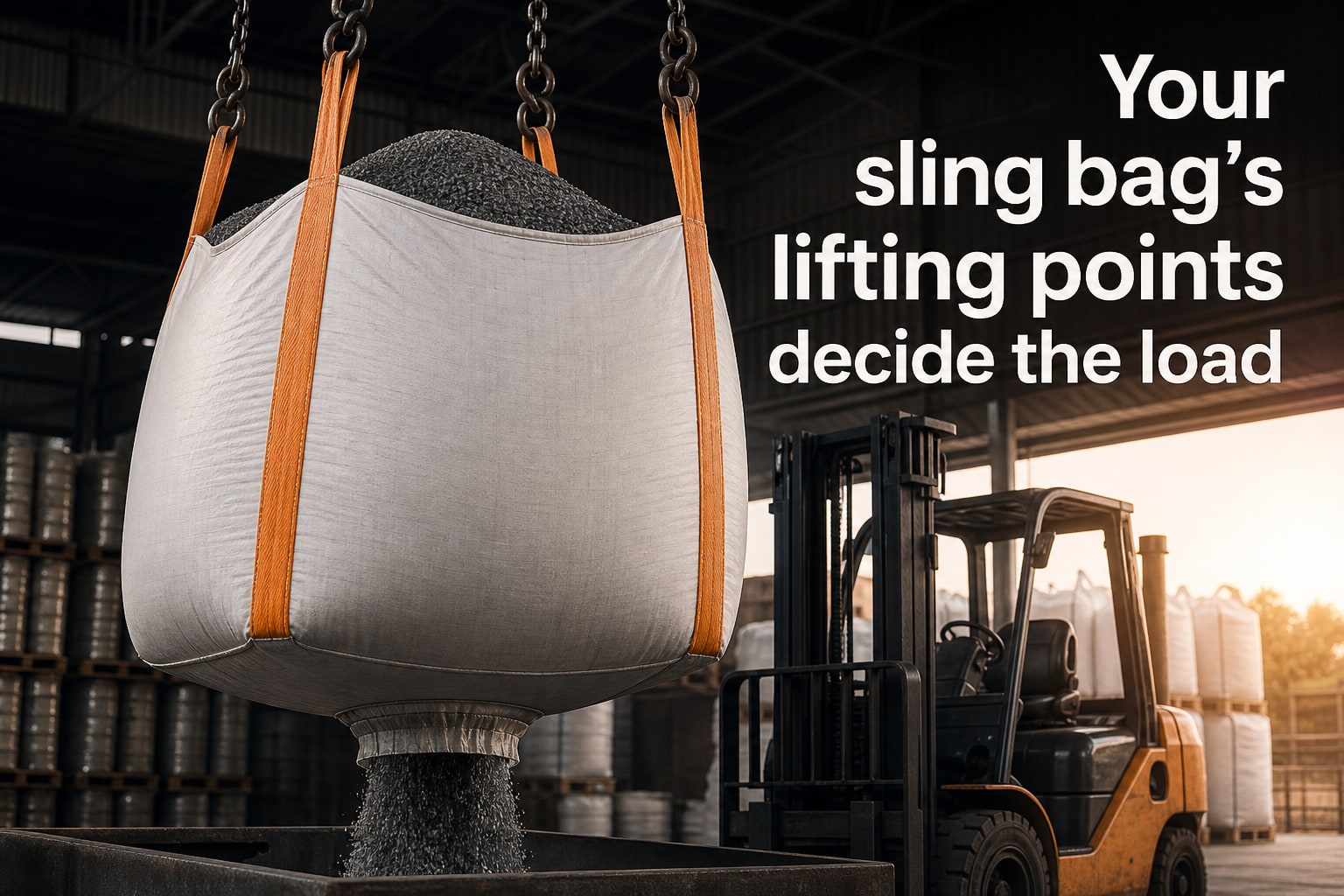
A cross-bottom sling bag earns its place when a filled FIBC must move safely through filling, storage, truck loading and customer unloading. You will learn how its four-point lifting arrangement works, which specifications control its real capacity, when another container is better, and what to ask before approving a supplier or sample.
Key takeaways
- Confirm SWL against the filled product, lifting equipment and handling cycle.
- Use four-point movement only when all loops and equipment suit the load.
- Specify discharge outlet, liner and fabric protection with the finished shape.
- Compare samples, seam details and test records—not the phrase heavy duty.
What the cross-bottom sling arrangement changes during lifting
Four lifting points change how a filled FIBC transfers weight into handling equipment. In a cross-bottom or cross-corner construction, straps run beneath or across the bag and are sewn into reinforced corner zones, forming four usable loops instead of one central loop.
The path differs by design: confirm whether the loops are integral straps, separately attached webbing or corner loops on the supplier’s drawing.
| Arrangement | Construction | Handling implication |
|---|---|---|
| 1-loop FIBC | One central lifting loop | Suits compatible single-hook equipment, not four-point lifting |
| 2-loop FIBC | Two opposed loops | Requires matched two-point lifting and balanced loading |
| Standard four-loop FIBC | Four loops attached at upper corners | Works with four-hook or compatible forklift handling |
| Cross-bottom or cross-corner | Straps pass under or across the bag into reinforced corners | Spreads load across the base and corner zones when all points share tension |
| Corner-loop design | Separate loops fixed at corner panels | Resembles four-loop lifting but depends on attachment and reinforcement details |
Four points reduce concentration at one lifting location during forklift, crane and four-hook handling, but they do not correct uneven hook spacing or side loading. “Cross-bottom,” “cross-corner” and “four-loop” are not controlled terms, so ask FIBC manufacturers in India for loop length and width, webbing width, stitch pattern, reinforcement detail, rated capacity and hook clearance.
Choose the drawing, not the product name.
Why Bengaluru operations favour four-point movement between handling stages
Four-point movement suits Bengaluru operations because one filled bag may pass through a filling line, warehouse aisle, narrow loading bay, truck and customer unloading area. Four lifting points give a forklift attachment, crane hook or hoist more handling options when each interface matches the bag’s loop geometry.
That advantage disappears if forklift tine spacing, hook radius or sling angle side-loads a loop. A side-loaded loop can deform, abrade or pull unevenly during a turn, creating delays precisely when monsoon conditions already slow loading and vehicle movement.
Before approving the bag, verify:
- The actual forklift tine spacing and attachment dimensions
- Hook radius, spreader-beam width and required loop clearance
- Vertical lifting alignment without side-loading
- A trial using the equipment that will handle the filled bag
- Manufacturing location, available local stock and custom-bag lead time
- Finished-bag test records, not fabric results alone
Searches for FIBC manufacturers in Bangalore can return traders, converters and factories outside the city. Confirm who manufactures the bag, where stock sits and how quickly a custom cross-bottom design can be supplied for an urgent packaging requirement.
Cross-bottom construction does not guarantee stable stacking. Filled height, footprint, product settlement, surface friction and baffle support determine whether bags lean or remain aligned. Run a loaded-stack trial using the intended warehouse height and footprint limits before relying on the lifting design.
How to match SWL, lifting equipment and safe handling practice
A stated SWL does not qualify a heavy-duty FIBC by itself. Specify SWL, safety factor, product bulk density, filling density, bag dimensions, lifting method, number of handling cycles, and whether service is single-trip or reusable.
A 5:1 safety factor generally indicates single-trip service; a 6:1 design is reusable only with manufacturer test evidence and an inspection regime.
| Option | Load interface | Choose when |
|---|---|---|
| Cross-bottom | Four integrated or attached lifting points | Forklift, crane or four-hook transfers need distributed support |
| Standard four-loop | Four corner loops | Equipment matches the loop spacing and hook clearance |
| 1-loop or 2-loop | One or two central lifting points | Handling equipment is designed for that arrangement |
| Rigid equipment | Fixed walls and lifting points | Repeated cleaning, stacking control or rigid protection matters more than flexibility |
Use this lifting sequence:
- Inspect fabric, seams, loops and attachments for cuts, abrasion, loose stitching or distortion.
- Centre the load and confirm that the filled bag is stable.
- Fit hooks or forklift attachments whose radius, spacing and throat match the loops.
- Keep every lifting point vertically aligned; never side-load a loop.
- Raise smoothly without snatching or shock loading.
- Keep people outside the suspended-load zone.
Reject the lift for damaged loops, incompatible hooks, unstable contents, sharp edges without suitable protection, side loading or lifting above personnel. Include the actual forklift, hooks or spreader beam in a packaging trial, because a strong bag can fail when its lifting geometry does not match the equipment.
Choose the filled shape, discharge outlet and material protection together
Select the bag’s filled shape, outlet and material protection as one system: the receiving hopper, conveyor or filling line determines the top construction, filling method, access arrangement and clearance beneath the bag.
| Bottom design | Outlet specification | Best fit |
|---|---|---|
| Flat bottom | No outlet, or a stated bottom spout | Discharge by cutting, tipping or external handling |
| Bottom discharge | Diameter, spout length, closure and support | Controlled emptying into compatible receiving equipment |
| Full-discharge or conical bottom | Separate outlet geometry and full-clearance drawing | Powders and fine granules needing low-residue discharge |
A loose outlet can restrict flow, spill product and expose operators. Ask for the outlet diameter, spout length, closure type, neck arrangement and support method; do not treat “heavy duty” as evidence of a conical or full-discharge construction.
- For cementitious powders, minerals, fertilizers, chemicals, food ingredients, starches and granules, specify fabric coating, liner resin, liner thickness, fit, sealing method and product-temperature limit.
- In Bengaluru’s humid storage and rainy conditions, laminated fabric or a PE liner reduces moisture ingress only when the liner neck, spout and closure are sealed.
- Specify Type A, B, C or D electrostatic classification. Type C requires conductive components and effective grounding.
- Food and pharmaceutical users should request traceability and cleanliness records for resin, fabric, liner, thread, coatings and recycled content.
A food-contact liner declaration does not cover every finished-bag component. UN marking applies only when the complete approved design matches the dangerous-goods requirement.
Compare quotations by finished-bag evidence, not by the word heavy duty
A quotation is comparable only when it describes the finished bag and its intended service. Ask each supplier for these fields before comparing price.
| Field | What to compare |
|---|---|
| Dimensions | Finished length, width and height, with filled-bag tolerances |
| Capacity | SWL, safety factor, bulk density, filling density and lifting method |
| Lifting | Loop geometry, webbing width, attachment points and hook clearance |
| Construction | Top style, bottom outlet or flat bottom, corner reinforcement and seam type |
| Protection | Liner resin and gauge, lamination, sift-proof seams and UV requirement |
| Control | Test frequency, batch traceability, number of handling cycles and single-trip or reusable rating |
High fabric tensile strength does not prove a safe bag. Request finished-bag seam testing and loop-load testing under ISO 21898 considerations, not only polypropylene fabric results.
Require these controls in writing:
- A controlled specification, approved drawing and pre-production sample
- An inspection plan identifying dimensions, seams, loops, outlets and test frequency
- Change notification for fabric coating, liner gauge, thread or loop webbing
Deccan Cans & Printers Pvt. Ltd. can be useful when Bengaluru stock, sample approval, delivery timing and factory testing matter; verify that its records cover the finished bag. Apply the same questions to heavy duty FIBC manufacturers in India and FIBC suppliers.
A lower quotation is not lower cost if its service cycle, liner, outlet or test evidence differs.
Choose woven sacks for smaller quantities or manual handling, pallets for unitised cartons, and rigid intermediate bulk containers when repeated cleaning, controlled stacking or rigid protection outweighs FIBC flexibility.
Related product
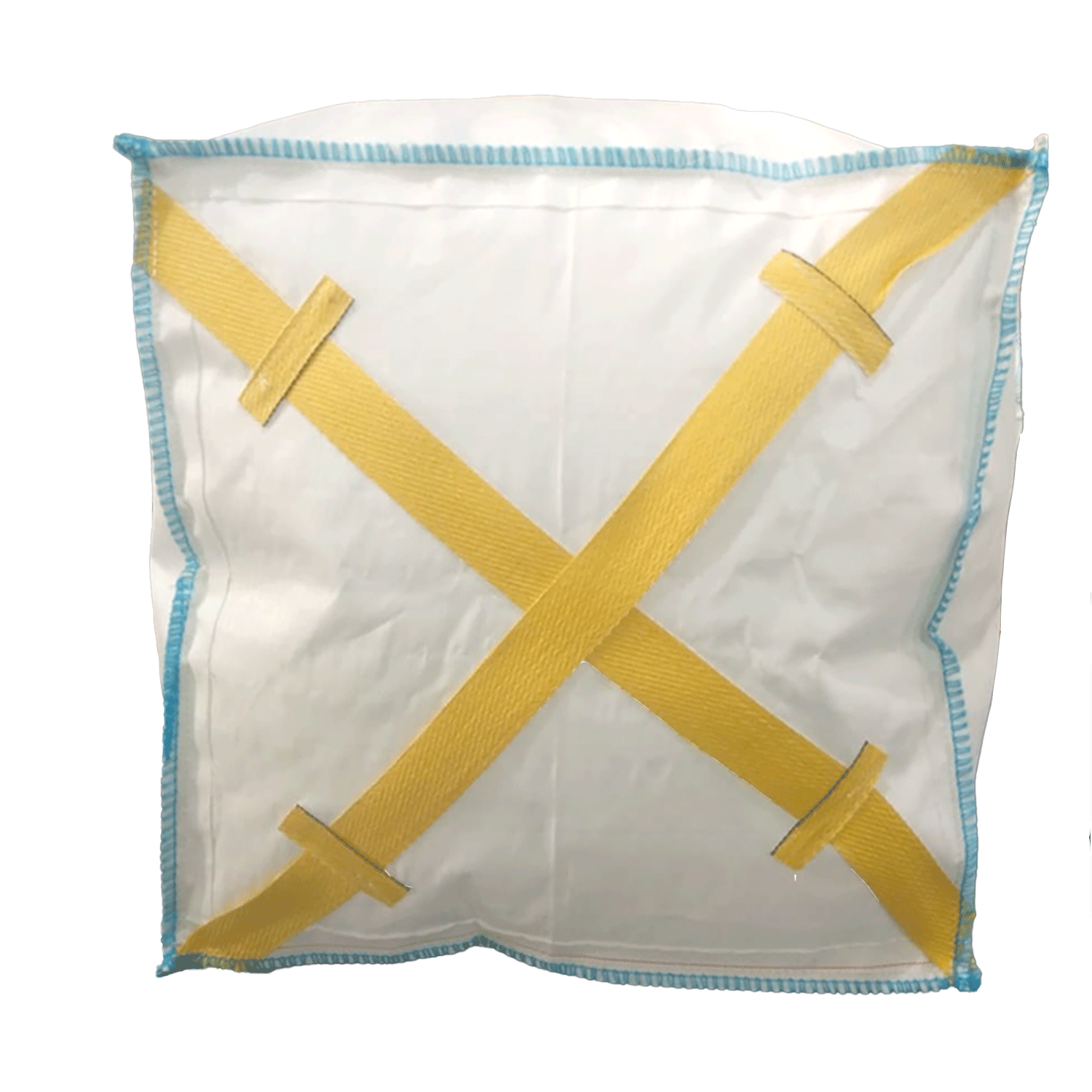 | FIBC Section Cross Bottom Sling Bags Cross Bottom Sling FIBCs – Bulk Bags Deccan Cans & Printers Pvt. Ltd. |
Frequently asked questions
What does a cross-bottom sling arrangement change during lifting?
Straps beneath or across the bag transfer the load into four reinforced corner zones, providing four usable lifting loops instead of one central loop.
Why do Bengaluru operations use four-point movement between handling stages?
Four-point movement suits operations that shift filled bags between forklifts, cranes, pallets and storage positions while keeping the load supported at multiple corners.
How do you match SWL, lifting equipment and safe handling practice?
Check the bag’s stated SWL against the filled product weight, lifting equipment capacity, loop configuration and the planned lifting cycle before use.
What should you specify besides the bag’s lifting construction?
Specify the filled shape, discharge outlet, liner or material protection, product flow requirements and the handling equipment used at each stage.
How can buyers compare heavy-duty FIBC quotations?
Request a finished-bag sample, SWL and safety-factor details, seam and loop construction, dimensions, outlet design and test evidence rather than relying on the words heavy duty.