
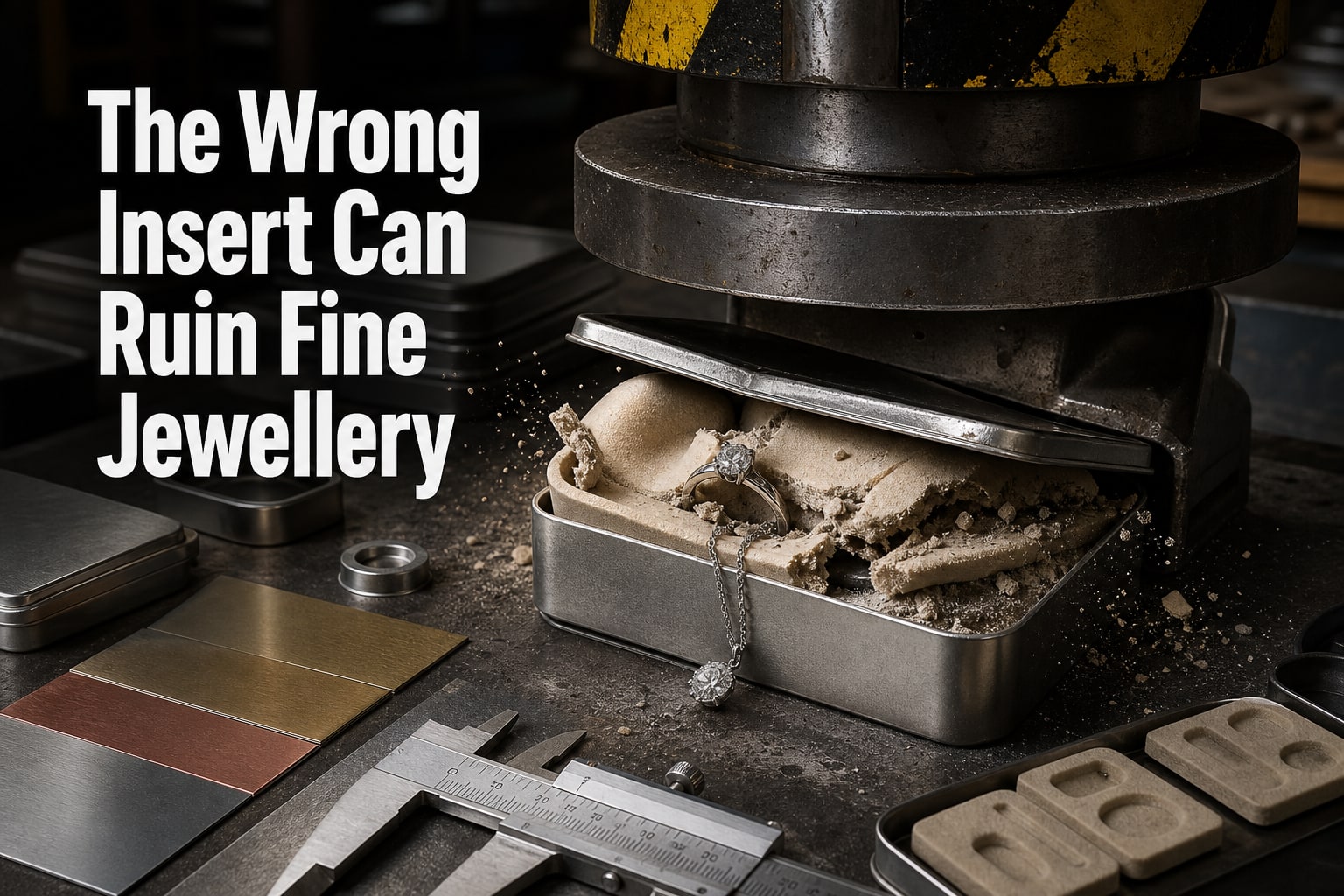
A jewellery tin that looks correctly sized can still fail when the insert, chain length, lid clearance or coating is ignored. You will be able to specify the usable cavity, choose the right closure and lining, compare quotations accurately, and approve samples that protect jewellery through storage, retail handling and transport.
Key takeaways
- Confirm whether quoted dimensions are external or usable internal cavity.
- Choose an insert that separates jewellery and protects surfaces from scratches.
- Compare metal, closure, finish, tooling and delivery details line by line.
- Approve a production sample before committing to the full batch.
Measure the jewellery and the usable cavity before ordering
An 80 × 25 mm or 50 × 25 mm quotation is useless until you know whether those figures describe the finished external size or the usable internal cavity. A 25 mm external height can disappear into the base, lid, lining and presentation card.
1. Measure every jewellery item at its maximum length, width and height. Add clearance for the lid, insert thickness and finger access. Measure a box by its outside dimensions, not by the jewellery inside it.
2. Match the cavity to the product. Rings may need a slit insert; earrings need protection for posts and backs; pendants need a recess; chains need a folded pouch or channel; bracelets need extra length and movement control; and loose stones need a sealed compartment.
3. Ask whether the quotation from a metal packaging manufacturer in Mumbai states external dimensions or internal usable dimensions. Put the required internal length, width, depth, corner radius, lid overlap and maximum product dimensions on the purchase order. Specify the insert footprint separately.
4. Request a dimensioned drawing and a cavity sample before approving production. Fit the actual jewellery with its insert, close the lid, remove it, and check that fingers can retrieve the item without forcing it. Record the maximum product dimensions and the usable cavity on the approved sample.
Choose an insert that stops scratches, tangling and tarnish
Use a shaped foam pad for rings and earrings, a velvet or flocked tray for presentation, a paperboard divider for separate pieces, or a fabric pouch for chains and plated items that can scratch one another. Add channels, loops or tabs to stop necklaces forming knots during transport.
| Insert | Best use | Main protection |
|---|---|---|
| Shaped foam pad | Rings and earrings | Holds each piece away from metal |
| Velvet or flocked tray | Presentation sets | Cushions surfaces and improves display |
| Paperboard divider | Separate pieces | Prevents contact between items |
| Fabric pouch | Chains and plated jewellery | Reduces rubbing and tangling |
Do not approve an insert from an empty-tin sample. Foam, rubber, adhesives, printed paper and some recycled materials can release sulfur compounds, chlorides or volatile chemicals that tarnish silver and plated surfaces, particularly at high humidity. Test the actual jewellery, insert, adhesive and tin together for the intended humidity and storage duration.
Ask a tin container manufacturer in Mumbai for the internal lacquer declaration and contact-compatibility evidence covering silver, gold plating, brass, nickel finishes, gemstones and elastomers. “Food-grade” does not prove jewellery compatibility. Keep stones away from rough seams, exposed cut edges and hard unlined metal.
Require the supplier to state whether the lining is bonded, loose-fit or mechanically retained; a lifted edge can mark jewellery during repeated packing.
Select the closure, metal specification and finish for the use case
Choose the closure by how the jewellery will be handled: a plain sliding lid preserves privacy and gives a clean gift presentation, while a windowed lid displays the piece at a counter but adds a transparent panel that needs scratch and yellowing checks. Neither is a hermetic moisture barrier.
| Option | Best use | Checks before approval |
|---|---|---|
| Sliding lid | Compact retail storage and repeated opening | Controlled fit, lid force, retention and dust ingress |
| Windowed lid | Counter display | Panel clarity, scratches, yellowing and secure attachment |
| Hinged lid | Gifting and presentation | Hinge alignment, lid squareness and closure retention |
Specify tinplate, not simply “tin.” Ask a tin container manufacturer in Mumbai for the steel substrate, nominal sheet thickness, tin-coating designation, temper, surface finish, passivation and internal lacquer system. Request details of seam, corner and cut-edge protection; tin coating alone does not prove corrosion resistance.
Put these limits into the purchase specification:
- Acceptable dents and wall-thickness variation
- Lid-force or retention range
- Coating adhesion and scuff resistance
- Stack-compression performance
- Window-panel scratch and yellowing limits
Approve colour and gloss on a production-process metal drawdown or pre-production tin, never a paper proof. The white basecoat, varnish, print registration and metal surface alter the final result. Record tolerances for colour, registration and gloss before production.
Compare the quotation and verify the Mumbai manufacturing route
A low unit price is not comparable until every cost and specification is visible. Ask for separate prices for:
- Tin body, lid, insert, printing plates, dies, embossing and other tooling
- Packing cartons, palletisation, freight, unloading, GST and rejected or damaged-piece allowance
Confirm whether the quote is ex-works or delivered, whether tins are nested, and whether protective interleaving increases the freight cube.
| Quote basis | What to confirm | Why it matters |
|---|---|---|
| Ex-works | Collection point and loading responsibility | You pay onward freight and unloading |
| Delivered | Destination, freight scope and unloading terms | “Delivered” can still exclude site handling |
| Standard sheet | Gauge, stiffness and closure-fit limits | Available material may produce a weak body or loose lid |
| Specified production | Thickness variation, dent limits and lid-force or retention range | These figures make competing quotes comparable |
For drawn, shaped, embossed or hinged designs, record the one-time die charge, embossing or tooling charge, ownership, revision cost and minimum economic batch. A tin box manufacturer in Mumbai should identify where body forming, lithographic printing, lacquering, assembly and inspection occur. Deccan Cans & Printers Pvt.
Ltd. is worth assessing by the same evidence as any supplier.
“Tin packaging company in Andheri East” identifies a procurement location, not a factory. Ask a metal packaging manufacturer in Mumbai for its production address, process photographs or a controlled factory visit, plus the inspection plan. Put tolerances and the inspection sample size into the order.
Related products
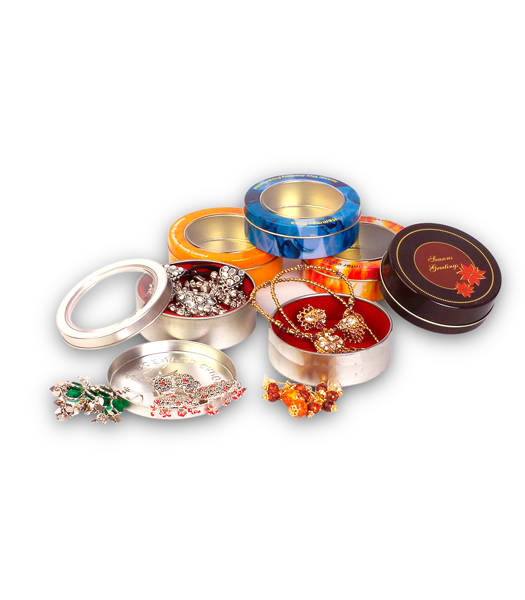 | Tin Containers Product Descriptions Deccan Cans & Printers Pvt. Ltd. 1. Sliding Jewellery Tin – 80 × 25 mm Product Code: 303*25Slid Size: 80 × 25 mm, available with... View product → |
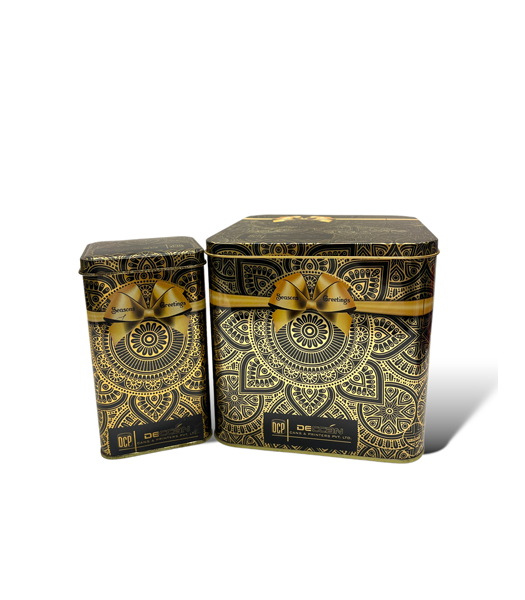 | Tin Containers Miscellaneous Tin Can Range – Product Descriptions Deccan Cans & Printers Pvt. Ltd. 1. View product → |
Approve a production sample before committing to the batch
A glossy sample can still have the wrong cavity, a loose lid or an edge that scratches jewellery. Approve the finished production sample against written limits before releasing the batch.
1. Measure internal and external length, width and depth with the insert installed. Record lid-on and lid-off force or retention. Inspect corner radii, seams, welds, rolled edges and exposed cut metal.
2. Test coating adhesion and abrasion or scuff resistance on the actual printed, lacquered surface. Run a stack-compression check when tins will travel in cartons or sit in retail piles.
3. Pack the intended rings, earrings, pendants, chains, bracelets, loose stones or boxed pieces. Use the final insert, carton and shipping orientation for the transit trial. After vibration, impact and storage, check for scratches, movement, tarnish, odour transfer and stone damage.
4. Keep the approved sample as the master. Write acceptance limits for colour, registration, gloss, dents, lid fit and insert placement, then use the same limits during production inspection.
Do not qualify jewellery tins and FIBC bulk bags through one sample process. An FIBC needs a defined safe working load, safety factor, construction type, liner, lifting-loop configuration, filling and discharge arrangement, electrostatic classification and ISO 21898 test evidence. Capacity in litres or kilograms alone is insufficient.
Ask a tin box manufacturer in Mumbai to record these results, not just provide photographs.
Frequently asked questions
Why must you distinguish external dimensions from the usable cavity?
An external measurement includes the tin wall, base, lid, lining and presentation card. Ask the manufacturer to state the finished external size and clear internal cavity separately.
Which insert is suitable for jewellery tins?
Choose an insert that holds each jewellery item securely, prevents pieces from rubbing or tangling, and keeps metal away from abrasive surfaces. Match the insert depth to the jewellery height.
What should you compare in a jewellery tin quotation?
Compare cavity dimensions, tinplate specification, closure type, finish, insert material, tooling charges, minimum order quantity, sample charges and delivery terms.
Why approve a production sample before ordering the batch?
A sample lets you check the actual cavity, lid fit, closure force, insert alignment, finish, print placement and jewellery protection before approving mass production.